RC Arcadia Index EA V1.11 MT5 — Order in Volatility for Daily Index Trading
Markets feel calm… until they don’t. If you’ve been frustrated by bots that shine in one regime and implode in the next, ARC Arcadia Index EA V1.11 (MT5) is built to do the grown-up thing: read the regime first, then decide whether to mean-revert, break out, or stand aside. It’s D1 (daily) timeframe by design, so you’re not glued to screens or whipsawed by intraday noise. No high-frequency gimmicks, no reactive overfitting; just clear trade cycles, consistent risk, and capital preservation when conditions turn hostile.
Arcadia is regime-aware. It fuses volatility percentiles with trend-strength proxies, applies noise-reduction filters to cut false starts, and enforces strict risk: a hard Stop Loss on every position, optional ATR-scaled trailing, and sensible opposite-signal exits. If your broker rejects stops on entry (it happens), Arcadia uses broker-safe routing—send market, attach SL immediately after fill. Default posture is one position per symbol (no pyramiding, no averaging down), which you can change—but honestly, most traders shouldn’t.
Overview — What ARCADIA Is (and what it isn’t)
- Timeframe: D1 per instrument, attach one chart per symbol.
- Market focus: Major equity indices (think US and global benchmarks).
- Core behavior: Switches among mean-reversion, breakout, or flat according to regime tests.
- Noise control: Confirmation logic and compression filters reduce whipsaw; an optional flip delay avoids rapid back-and-forth near turning points.
- Risk discipline: Every trade has a hard SL; ATR trailing optional; opposite-signal exits available.
- Execution safety: Broker-safe routing if stops are rejected on entry.
- Position limits: One position per symbol by default; no pyramiding/averaging down (toggleable for advanced users).
- Infrastructure: ECN/STP, raw spread, realistic commissions and slippage modeling, VPS recommended.
- Sizing: Fixed lot or %-of-balance risk; keep risk per trade modest and consistent.
- Testing: Use real-tick modeling, then forward-test on demo. Validate per symbol and review correlation if you’re running a basket.
Arcadia is not a scalper, not a grid, and not a martingale. It’s a slow, deliberate D1 engine that tries to be on the right side of regimes rather than every wiggle.
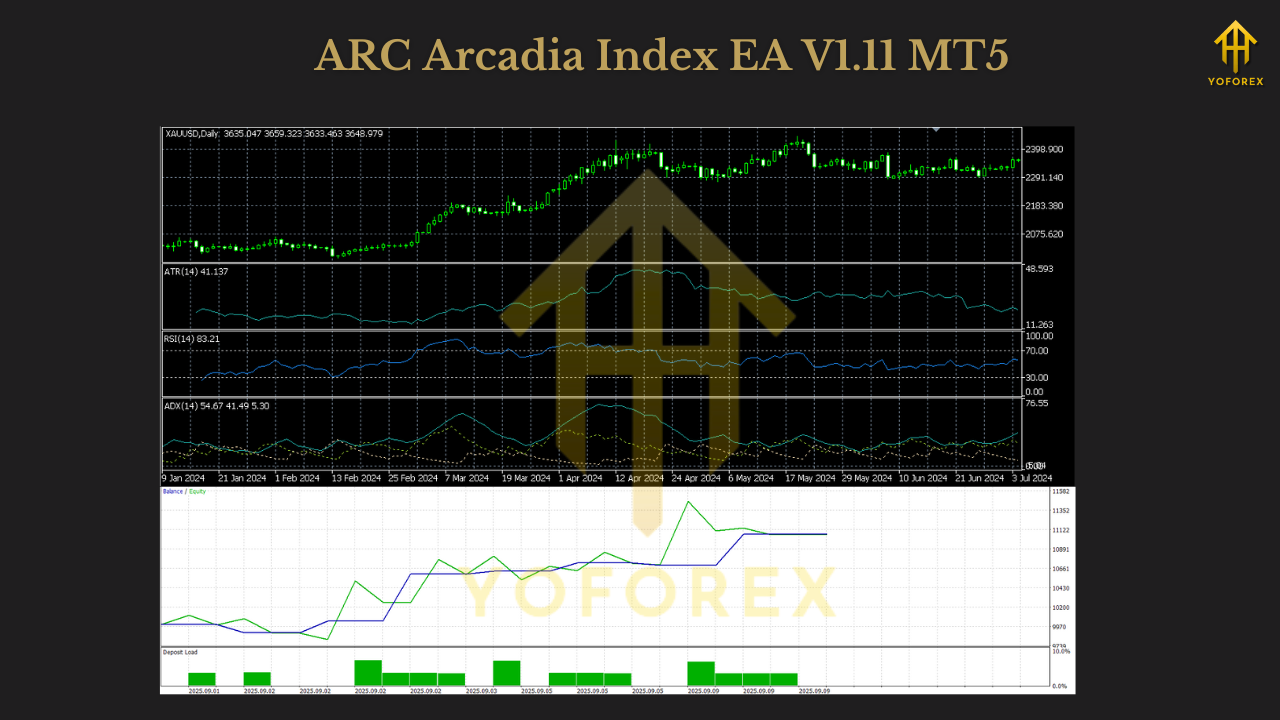
How the Strategy Thinks — Regime Control, Not Guesswork
1) Measure the regime.
Arcadia evaluates volatility percentile (e.g., where today’s ATR sits relative to its lookback) and trend strength (directional bias via moving-slope/ADX-style proxies). High vol + strong slope often tilts toward breakout follow-through; compressed vol + weak slope tilts toward mean-reversion. Messy or conflicting signals? Stand aside.
2) Reduce noise.
Before any order, Arcadia applies entry confirmations (close location vs. structure, distance from compression bands) and compression filters aimed at filtering “fake breaks.” An optional flip delay keeps the EA from ping-ponging when the market hesitates around key pivots.
3) Enforce hard risk.
Every entry comes with a hard Stop Loss. The ATR-scaled trailing can kick in after initial progress, balancing room to breathe with protection. Opposite-signal exits provide a clean eject if the narrative flips.
4) Keep exposure tidy.
By default, it’s one position per symbol. That choice prevents over-stacking risk on a single index. Advanced users can customize—just remember correlation risk across indices can be brutal when macro headlines hit.
Why D1 for Indices?
Daily bars filter the majority of intraday noise while capturing meaningful structural shifts—trend resumptions, failed breaks, volatility regime changes. You get fewer, higher-quality decisions, and you’re far less exposed to broker microstructure (spreads, last-look, roll). It’s also lifestyle-friendly: review once a day, not every ten minutes.
Setup & Installation (MT5)
- Download & copy: MT5 → File → Open Data Folder → MQL5/Experts → paste the EA.
- Restart MT5; in Navigator → Experts, drag ARC Arcadia Index EA V1.11 onto a D1 chart for each index you want to trade.
- Inputs (sane starters):
- Risk per trade: 0.25%–0.75% (or small fixed lot).
- ATR period & trailing: defaults are balanced; enable trailing only after you review a few trades.
- Flip delay: keep it on for the first month.
- Max positions per symbol: 1.
- AutoTrading ON; confirm algo permissions and that your broker supports hedging if you plan to run multiple symbols.
- VPS: strongly recommended for consistent daily checks and stable execution around session opens.
Recommended Infrastructure & Broker Settings
- Account type: ECN/STP with raw spreads on index CFDs.
- Commissions & slippage: Model realistically; you want conservative, not flattering, tests.
- Symbol suffixes: Watch for broker suffixes (e.g., US500.cash, GER40.m). Map each chart correctly.
- Server time: D1 close time varies by broker; be consistent. If your backtest and live differ in session cuts, behavior can drift.

Risk Management — Keep It Boring (That’s Good)
- Fixed lot vs. % risk: If you’re new, use % risk so your size adapts as equity changes.
- Drawdown governance: Set a daily/weekly equity guardrail at the account level. D1 systems rarely need more than a few decisions per week—no need to press.
- No pyramiding/averaging down (default): Let the signal stand on its own. If you enable stacking later, do it with tiny increments and hard caps.
- Basket correlation: If you run multiple indices, cap total simultaneous risk. US indices often correlate; don’t unknowingly triple your exposure.
Backtesting & Forward Testing (Do Both)
- Backtest: Use real-tick or the highest fidelity your tester allows. Cover multiple years—calm regimes, crisis spikes, policy shifts. Focus on max drawdown, avg trade length, win/loss by regime, and exposure overlap if you plan a basket.
- Walk-forward / OOS: Validate the parameter stability. Arcadia isn’t a hyper-tuned scalper; it should hold up OOS if you keep risk modest.
- Forward demo: Run a 4–8 week demo on the same broker you’ll use live. Confirm order routing (SL acceptance), slippage behavior around opens, and any symbol-specific quirks.
- Go live gradually: Start with half your demo risk for the first month; review weekly.
Practical Playbook — How to Operate Day to Day
- Check once daily after the D1 close on your broker. Confirm there’s no pending error, spread anomaly, or chart mismatch.
- Respect macro calendars. D1 helps, but CPI/Fed/ECB days can still shock indices. You don’t need to halt the EA, but be aware.
- Journal simply: Regime label, trade direction, position size, ATR multiple for SL, and whether trailing/flip delay engaged. This builds trust in the process.
- Avoid tinkering mid-trade. Let the logic complete unless you see a hard error or broker execution problem.
Who Will Like Arcadia
- Traders who value structured, low-touch systems driven by regime detection rather than constant fiddling.
- Portfolio builders running multi-asset baskets who want an index sleeve with clean risk rules.
- Anyone exhausted by HFT-ish systems that die when volatility/structure shifts.
Who won’t: Grid/martingale fans, scalpers seeking dozens of trades per day, and anyone hoping to game slippage on sub-second fills. That’s simply not Arcadia’s lane.
Final Word
ARC Arcadia Index EA V1.11 MT5 is a calm operator in chaotic markets. It reads volatility and trend context, acts only when odds are acceptable, and exits cleanly when the story changes. Keep risk small and steady, test properly, and don’t fight correlation. It’s not flashy—but when you look back after a quarter, “boring” is often what preserved and grew the account.
Join our Telegram for the latest updates and support
Comments (0)
No comments yet. Be the first to comment!
Leave a Comment