
AxonShift EA V1.2 MT5 – Structured Gold Trading on H1
If you’ve been hunting for a gold-focused Expert Advisor that doesn’t rely on gimmicks or hyperactive scalping, AxonShift EA V1.2 for MT5 is worth a close look. It’s built for one job—trading XAUUSD on the H1 timeframe—using a layered decision model that blends short-term dynamics with intermediate trend impulses. Instead of firing dozens of trades per hour or curve-fitting to last month’s data, AxonShift moves in measured, controlled cycles. That’s the core promise: fewer, higher-quality decisions guided by structure, not noise.
Below, you’ll find a full overview of the EA’s design philosophy, logic modules, risk controls, and setup guidance, plus practical tips to get the most from H1 gold trading without overexposing your account.
What Is AxonShift EA V1.2 MT5?
AxonShift is an autonomous trading algorithm designed specifically for XAUUSD under H1 conditions. Think of it as a “structured interpreter” of market behavior. It doesn’t chase every candle tick; it waits for the market to align across two primary layers:
- Short-Term Dynamics – Micro momentum, volatility pulses, and session-driven liquidity pockets.
- Intermediate Trend Impulses – The broader directional bias, measured via trend structure, pullbacks, and continuation zones.
When both layers line up, AxonShift triggers a controlled trade cycle. That cycle can include a single entry or a staggered scale-in with strict caps, always under predefined risk. The aim is consistency under varying volatility regimes, not fragile optimization.
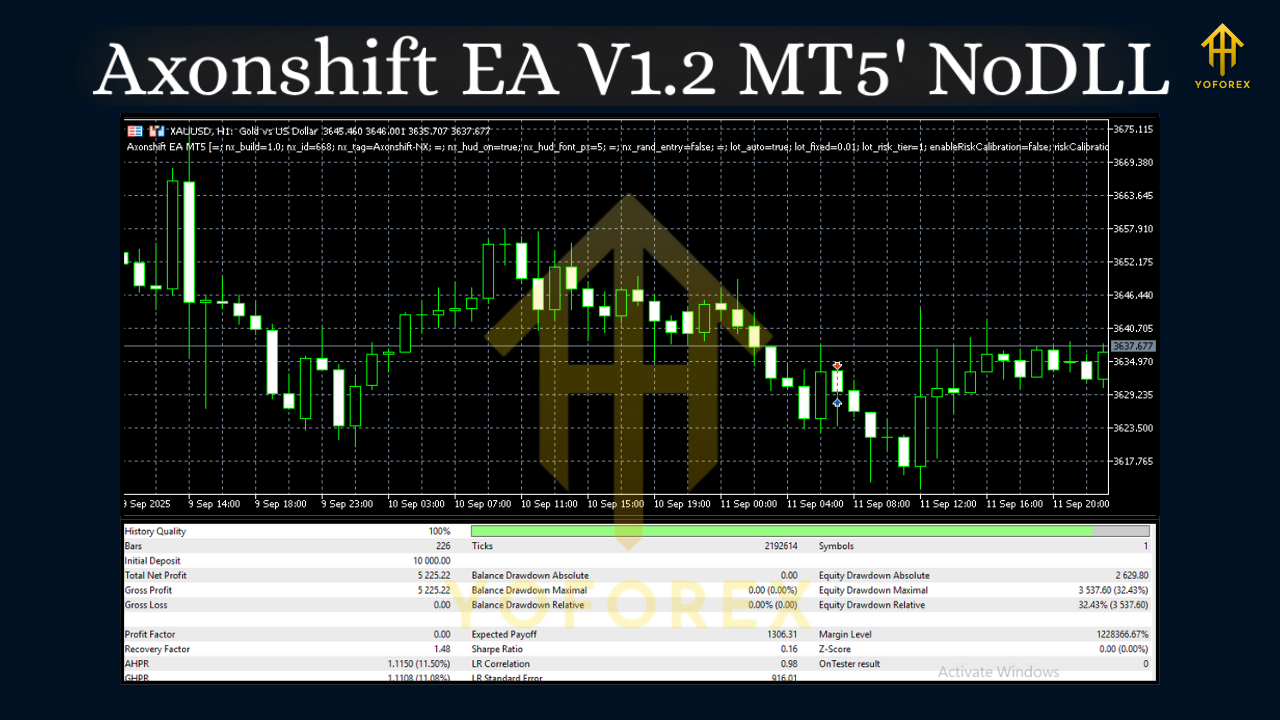
Why H1 for Gold?
Gold’s intraday structure is spiky; spreads and slippage can punish hyper-scalping. H1 smooths the noise while capturing robust moves from London and New York sessions. On H1, you can:
- Filter out micro-whipsaws common on M1–M5.
- Let momentum and trend alignment “breathe” before entry.
- Size risk more rationally (ATR-based stops, event filters, etc.).
AxonShift embraces this reality: fewer trades than a scalper, but more signal quality and a cleaner equity curve potential—especially when paired with realistic risk settings.
Core Architecture & Logic Modules
1) Market State Mapper
This module evaluates the backdrop: is gold expanding or contracting in volatility? Are we in an impulse leg or a corrective leg? The Mapper toggles AxonShift between “seek setups” and “standby.”
2) Short-Term Dynamics Scanner
Focuses on momentum bursts, micro pullbacks, and session context. It looks for alignment between price acceleration and volatility normalization—entries only when short-term behavior supports the higher-level bias.
3) Intermediate Impulse Engine
Determines if the dominant swing structure favors continuation or reversal. The Engine won’t allow trades against a well-formed impulse unless a high-quality reversal signature emerges.
4) Risk & Exposure Governor
AxonShift’s guardrail. It caps the number of simultaneous orders, respects max daily risk, and enforces a minimum R-multiple expectation per trade cycle. No martingale, no grid averaging into disaster—ever.
5) Trade Lifecycle Controller
From entry to exit, it manages stop placement, break-even logic, partial profits, and time-based exits when momentum fades. If the market stalls, the Controller closes positions rather than “hoping.”
Strategy Behavior in Plain English
- Entries: Only when short-term momentum confirms the intermediate trend direction (or a clear reversal structure forms).
- Stops: Typically ATR-informed, placed outside obvious noise bands so normal volatility doesn’t shake you out instantly.
- Targets: Adaptive. When momentum remains healthy, AxonShift trails; when energy fades, it banks partial profits and tightens risk.
- Frequency: Moderate. Expect selectivity, not HFT chatter.
- News: Optional filters can keep the EA flat during major events if you prefer—useful for gold’s explosive macro releases.
Who Is It For?
- Swing-intraday traders who prefer clean, higher-timeframe signals.
- Risk-first traders who want guardrails and dislike martingale/grid.
- Prop-firm aspirants who need consistency, capped drawdowns, and rule-friendly behavior.
- Busy traders who don’t want to babysit a scalper all day.
Setup & Installation (MT5)
- Install the EA: Copy the AxonShift EA file into
MQL5/Expertsand restart MetaTrader 5. - Attach to XAUUSD H1: Open a fresh XAUUSD chart, switch to H1, and drag AxonShift onto the chart.
- Enable Algo Trading: Toggle AutoTrading on; confirm DLL/Algo permissions if prompted.
- Set Risk Parameters: Choose fixed-lot or percent-risk per trade (e.g., 0.5%–1% per cycle).
- Configure Filters: If desired, enable session filters (e.g., prioritize London/NY overlap) and news avoidance.
- Run on a Reliable VPS: Gold can spike; a stable, low-latency VPS minimizes slippage.
Recommended Parameters (Starting Point)
- Account Type: ECN/RAW preferred for tighter spreads.
- Leverage: 1:200 to 1:500, but size conservatively.
- Risk per Trade Cycle: 0.5%–1.0% for most accounts; 0.25% if you’re ultra-conservative.
- Max Concurrent Positions: 1–3 (depending on your equity and comfort).
- Daily Max Loss: 2%–3% hard cap; if hit, the EA stops trading for the day.
- ATR Multiplier for SL: Start around 1.5–2.2 ATR (H1).
- Adaptive TP/Trail: Enable partials at 1.0R–1.5R; trail the remainder with a volatility-aware stop.
These are baseline suggestions—not financial advice. Always forward-test on demo before going live.
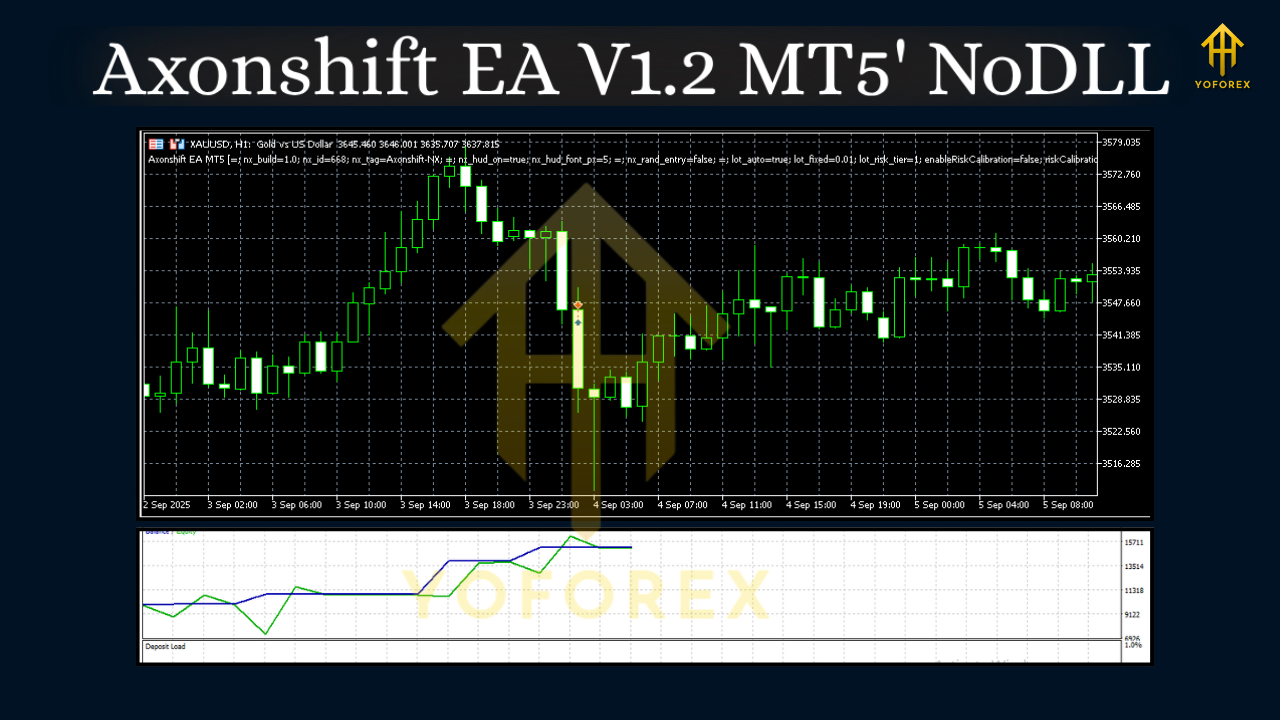
Risk Management & Prop-Firm Considerations
AxonShift’s Governor helps keep drawdowns in check, but your settings matter:
- Use a daily loss limit so a bad session doesn’t cascade into rule violations.
- Avoid over-leveraging just because gold is “moving.” Volatility can be a double-edged sword.
- If your prop rules prohibit trading through certain news events, enable AxonShift’s avoidance window around those releases.
- Keep max exposure lean. One good H1 setup often beats five mediocre ones.
Backtesting & Forward Validation Tips
AxonShift is intentionally designed to avoid reactive overfitting. To evaluate it fairly:
- Test across regimes: Include quiet months and high-volatility periods.
- Use realistic modeling: Incorporate spread, commission, and slippage in your tester settings.
- Focus on distribution: Look at win/loss clusters, average R per cycle, and how the strategy behaves after losing streaks.
- Forward-test: Even a few weeks of forward data on a demo/VPS tells you a lot about live behavior vs. backtest.
Remember: past performance isn’t a guarantee. The goal is a robust process that adapts to shifting volatility, not a perfect equity line.
Practical Playbook for Users
- Start with 0.5% risk per cycle for the first 2–3 weeks.
- Review daily logs—confirm entries align with your understanding of the trend + momentum premise.
- If you notice over-trading on thin liquidity hours, use session filters to restrict entries.
- Revisit your ATR-based SL if you’re getting clipped by normal H1 noise; sometimes a slightly wider stop improves expectancy.
- Keep psychology in check: AxonShift is selective; don’t manually override it just because you’re impatient.
Final Word
AxonShift EA V1.2 MT5 is about structure, not spectacle. It respects risk, aligns multiple time perspectives, and treats gold like the high-energy instrument it is—carefully. If you want an H1-centric approach that favors quality over quantity, AxonShift’s controlled trade cycles and layered logic can slot nicely into a disciplined portfolio.
Comments (0)
No comments yet. Be the first to comment!
Leave a Comment