
Climbing Scalper EA V1.0 MT4 — Built for Calm, Night-Session Precision
If you’ve ever watched the market drift quietly after New York close and thought, “there’s got to be a safe, systematic way to harvest those tiny moves,” this one’s for you. Climbing Scalper EA V1.0 (MT4) is specifically engineered for the market’s calmest periods—typically during the Asian session—when spreads are tighter, volatility is friendlier, and price action often respects ranges better than during high-energy sessions. Compatible with EURUSD, AUDUSD, EURCAD, GBPUSD, and USDCAD on M5, M15, and H1, the EA uses a disciplined ruleset to seek high-probability entries, then exits fast to keep risk contained. No drama, no chasing… just methodical night scalping.
What Makes a Night Scalper Different?
Night scalpers aren’t trying to catch huge breakouts. Instead, they capitalize on mean-reversion and micro-momentum that appear when the market is quieter and spreads are thinner. The Climbing Scalper EA follows that ethos. It evaluates the immediate intraday context—recent volatility, micro structure, and spread conditions—to decide whether it’s worth taking the next small step up the “climb.” When it is, the bot seeks precise entries and tightly controlled exits, often closing trades within minutes to a couple of hours rather than holding overnight risk into busier sessions.
Key upside: during Asian hours (roughly 22:00–02:00 UTC, depending on your broker), spreads can be materially lower on major pairs. That can make or break any scalping approach. Climbing Scalper is built to avoid poor-quality conditions, sit out chop when needed, and re-engage when its filters realign.
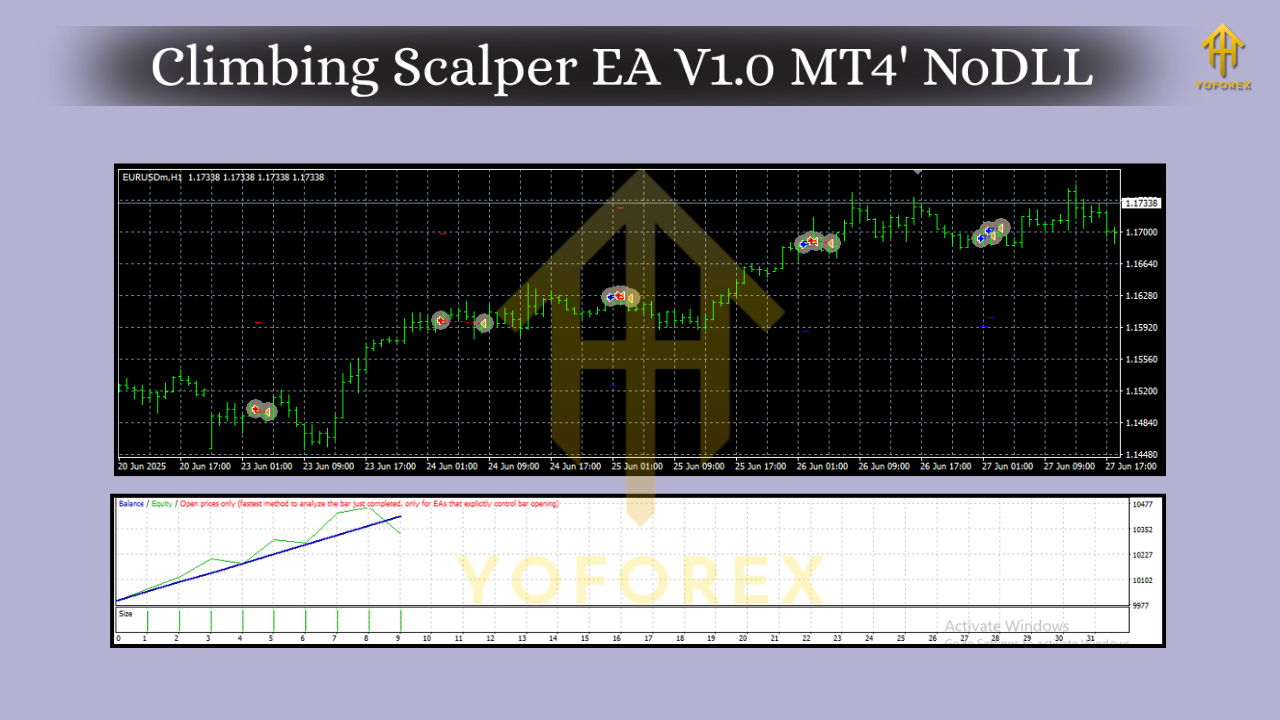
Supported Pairs & Timeframes
- Pairs: EURUSD, AUDUSD, EURCAD, GBPUSD, USDCAD
- Timeframes: M5, M15, H1
Why these? Majors and select crosses typically offer more reliable liquidity and lower spread in the night session. M5 and M15 give the EA a sharper view for scalping; H1 can smooth out noise for traders who prefer fewer but potentially cleaner signals.
Strategy Logic (High Level)
Climbing Scalper EA combines a few building blocks common in robust night scalpers—implemented with strict controls:
- Session Filter: Focus on post-NY close / Asian session windows where spreads and volatility tend to be friendlier.
- Spread & Slippage Guardrails: Trades are blocked if spreads widen beyond a threshold or if slippage exceeds a limit—critical for protecting scalps.
- Micro-Trend & Mean-Reversion Balance: The EA watches for short-term imbalance (micro-trend) but quickly reverts to range assumptions if momentum fades.
- Adaptive Stops: ATR-based stop loss sizing (or fixed pips by pair) keeps risk proportional to the environment.
- Tight, Logic-Driven Exits: Small, repeatable targets, with logic to cut losses early if invalidation triggers.
- Trade Frequency Moderation: Designed to avoid over-trading; a handful of high-quality setups beats dozens of low-quality ones.
No grid. No martingale. Just a clean, rules-based system aimed at consistency over excitement.
Feature Highlights
- Asian-session optimized execution to exploit quieter order flow
- Multi-pair coverage: EURUSD, AUDUSD, EURCAD, GBPUSD, USDCAD
- Timeframe flexibility: M5/M15 for active scalps, H1 for calmer pace
- Spread/slippage filters to protect small profit targets
- ATR-aware stops or fixed-pip SL/TP per symbol
- Built-in session window and cooldown logic to avoid clustering trades
- One-trade-at-a-time per symbol (recommended) for tidy risk
- No martingale or grid—risk remains linear and transparent
- Magic numbers & comments for easy tracking and reporting
- News awareness (user-controlled): pause trading around major events via time-filters
Recommended Setup & Broker Considerations
Account & Broker:
- Use an ECN/RAW spread account with consistently low night spreads (EURUSD often stays tight even at night; crosses vary).
- Leverage: 1:100 to 1:500 is common; leverage isn’t a strategy, but it provides margin headroom.
- Minimum Deposit: Many night scalpers operate fine from $200–$500; more capital allows smaller relative risk per trade.
VPS:
- Since trades can open and close quickly, a low-latency VPS near your broker’s server is strongly recommended. Stability > everything.
Platform:
- MT4 is required. Keep it up to date. Disable unnecessary indicators/EAs on the same terminal to minimize lag.
Position Sizing & Risk Management
Scalping success lives and dies with risk control. Consider:
- Risk per trade: 0.5%–1.0% is a sensible starting point; tighter if you’re new.
- Max open exposure: Limit to one position per pair concurrently.
- Daily loss cap: A simple rule like -2R or -3R for the day can prevent spirals.
- Weekly guardrail: If you hit a weekly limit (e.g., -5R), pause and review conditions.
Pro tip: Resist the urge to widen stops for “just this one trade.” Scalping assumes quick invalidation. If the idea breaks, exit and wait for the next clean signal.
Backtesting & Forward Validation
To get a realistic picture:
- Data Quality: Use the highest-quality tick data available (true spreads/commissions).
- Session Hours: Make sure your test aligns with the EA’s intended session. If your broker is offset from UTC, adjust settings accordingly.
- Symbol Specificity: Calibrate SL/TP and max spread per symbol. EURUSD and GBPUSD behave differently at 01:00 UTC than USDCAD or EURCAD.
- Monte Carlo / Walk-Forward: If you can, stress test by randomizing spreads, slippage, or start date. It helps reveal fragility.
Forward test on demo first for 1–2 weeks. Check trade frequency, average win/loss, and whether execution speed on your setup matches backtest assumptions. When you go live, start small and scale gradually if results match expectations.
Practical Tips for Better Fills
- Avoid major news windows: Even if you trade nights, AU/JPY or CNY data can still surprise. Consider pausing around scheduled releases.
- Spread checks: Set a max spread per symbol (e.g., 1.5–2.0 pips for EURUSD; others adjusted to their typicals).
- Slippage tolerance: Keep it modest; if your broker frequently exceeds it, reassess environment or VPS proximity.
- Market open quirks: Tokyo open can cause brief spurts; the EA’s filters help, but you can add a few minutes of buffer if you prefer.
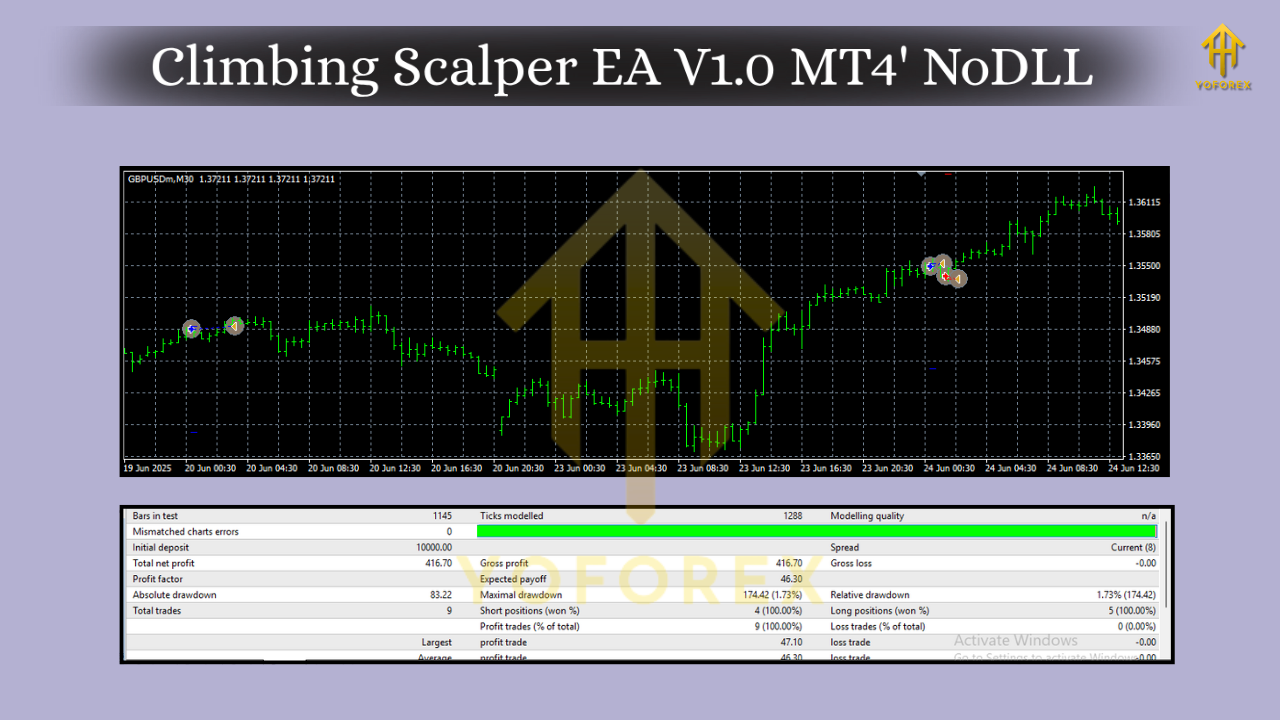
Installation (MT4)
- Copy EA: Place
Climbing Scalper EA V1.0.ex4into MQL4/Experts. - Restart MT4: Or refresh the Navigator so the EA appears under Experts.
- Attach to Chart: Open a M5 or M15 chart (start with EURUSD for baseline), then drag the EA on.
- Allow Live Trading: Check “Allow live trading” and “Allow DLL imports” if required.
- Configure Inputs:
- Risk per trade (lot or % balance)
- Trading hours/session window
- Max spread & slippage
- SL/TP method (ATR or fixed pips)
- Magic number & comment
6. Run on Demo: Verify logs for any errors, then monitor a few sessions before going live.
Example Baseline Settings (Starting Point)
Adjust to your broker’s reality—these are illustrative, not prescriptions.
- Symbol: EURUSD
- Timeframe: M5
- Risk: 0.5% per trade
- SL/TP: 1.3×ATR(14) SL, 0.8×ATR(14) TP (or fixed 8–12 pip TP, 12–18 pip SL)
- Session: 22:30–02:30 UTC (or match your broker’s Asian hours)
- Max Spread: 1.8 pips (tighten if your broker is better)
- Max Slippage: 1–2 points
- News Pause: 10–15 minutes around medium/high impact events
Who Is It For?
- Traders who prefer low-drama sessions and systematic, rules-based entries
- Part-time traders who can’t sit through London/NY intensity but can set and forget a VPS
- Risk-first scalpers who value small, frequent edges over big swings
If you’re more of a swing/breakout trader during London, you can still run Climbing Scalper at night and keep your discretionary system separate during day hours—just ensure position limits and risk don’t collide.
Final Word (Read This)
Climbing Scalper EA V1.0 MT4 is crafted for repeatable, small-edge trading in the calmest parts of the day. The edge is real—but it’s conditional on spreads, execution, and discipline. Use a reputable broker, a VPS, and modest risk. Always forward-test before going live, and treat settings as starting points you’ll refine to fit your broker’s microstructure.
Comments (0)
No comments yet. Be the first to comment!
Leave a Comment