Introduction
The Double Exponential Moving Average (DEMA) is a powerful technical analysis tool designed to reduce lag and provide smoother price trends compared to traditional moving averages. Developed by Patrick Mulloy, the DEMA indicator is widely used by traders to identify trends, generate buy/sell signals, and improve trading accuracy.
In this guide, we’ll explore how the DEMA indicator works, its advantages, and how to use it effectively in MetaTrader 4 (MT4). Whether you're a beginner or an experienced trader, understanding the DEMA can enhance your trading strategy.
What Is the DEMA Indicator?
The DEMA indicator is a type of moving average that applies a double smoothing technique to price data. Unlike a Simple Moving Average (SMA) or Exponential Moving Average (EMA), which can be lagging, the DEMA reduces delay by incorporating a second EMA calculation. This makes it more responsive to price changes while maintaining smoothness.
Key Features of the DEMA Indicator
- Reduced Lag: Minimizes delays in trend detection.
- Smoother Trends: Provides cleaner signals compared to traditional EMAs.
- Versatility: Works well in various markets, including forex, stocks, and cryptocurrencies.
How Does the DEMA Indicator Work?
The DEMA is calculated using the following formula:
DEMA = (2 × EMA) – EMA of EMA
Where:
- EMA = Exponential Moving Average
- EMA of EMA = The EMA applied to the initial EMA
This dual-smoothing technique helps eliminate noise while keeping the indicator responsive to recent price movements.
DEMA vs. EMA vs. SMA
- SMA: Simple Moving Average, equally weighted, but has significant lag.
- EMA: Exponential Moving Average, gives more weight to recent prices, reducing lag.
- DEMA: Further reduces lag by double-smoothing the EMA, making it faster and more accurate.
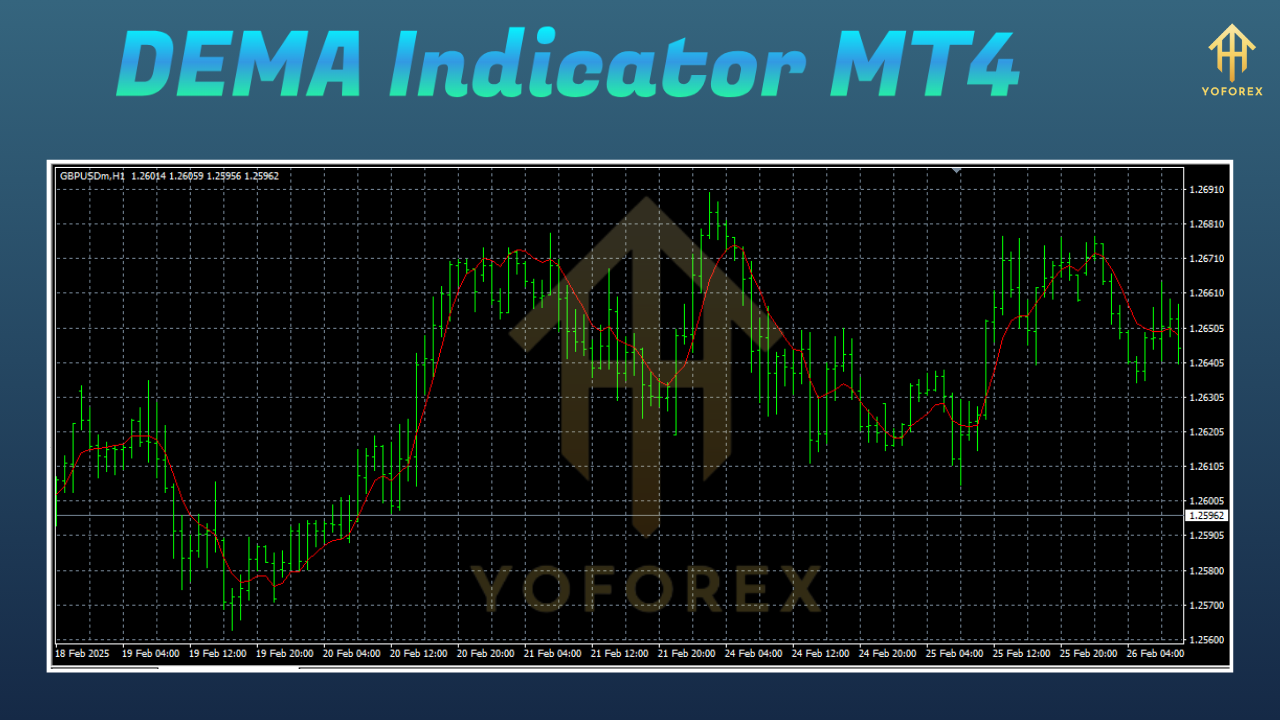
How to Use the DEMA Indicator in MT4
Step 1: Adding the DEMA Indicator to MT4
- Open MetaTrader 4 (MT4).
- Click on Insert → Indicators → Trend → Double Exponential Moving Average.
- Set your preferred period (e.g., 14, 20, or 50) and click OK.
Step 2: Customizing the DEMA Settings
- Period: A shorter period (e.g., 10) makes the DEMA more sensitive, while a longer period (e.g., 50) smooths out fluctuations.
- Apply to: Choose between Close, Open, High, Low, or other price data.
- Color & Style: Adjust the line color and thickness for better visibility.
Step 3: Trading Strategies with DEMA
1. Trend Identification
- Uptrend: Price stays above the DEMA line.
- Downtrend: Price stays below the DEMA line.
2. Crossover Strategy
- Buy Signal: When a faster DEMA (e.g., 10-period) crosses above a slower DEMA (e.g., 20-period).
- Sell Signal: When a faster DEMA crosses below a slower DEMA.
3. Support & Resistance Levels
- The DEMA can act as dynamic support in an uptrend and resistance in a downtrend.
Advantages of the DEMA Indicator
✅ Faster Response: Reacts quicker to price changes than SMA or EMA.
✅ Reduced Noise: Smoothens out false signals.
✅ Adaptable: Works across multiple timeframes (scalping, swing trading, long-term investing).
Limitations of the DEMA Indicator
❌ Whipsaws in Sideways Markets: Can generate false signals in ranging markets.
❌ Not a Standalone Tool: Best used with other indicators like RSI or MACD for confirmation.
Best Practices for Trading with DEMA
- Combine with Other Indicators: Use RSI, MACD, or Bollinger Bands for better confirmation.
- Avoid Over-Optimization: Stick to standard periods (10, 20, 50) instead of extreme values.
- Backtest Your Strategy: Test DEMA-based strategies on historical data before live trading.
Conclusion
The DEMA indicator is a powerful tool for traders seeking smoother and more responsive trend signals. By reducing lag and improving accuracy, it helps traders make better-informed decisions in fast-moving markets. When combined with other technical analysis tools, the DEMA can significantly enhance trading performance.
If you're using MT4, integrating the DEMA indicator into your strategy can provide a competitive edge. Start experimenting with different settings and see how it improves your trading results.
FAQs About the DEMA Indicator
Q: What is the best period for DEMA?
A: Common periods include 10, 20, or 50, depending on your trading style.
Q: Can DEMA be used for scalping?
A: Yes, shorter periods (e.g., 5-10) work well for scalping.
Q: How is DEMA different from TEMA (Triple EMA)?
A: TEMA applies triple smoothing, making it even more responsive but potentially noisier.
Q: Is DEMA better than SMA?
A: Yes, for trend-following strategies, DEMA reduces lag and provides smoother signals.
By mastering the DEMA indicator, traders can gain a significant advantage in identifying trends and executing timely trades. Try it out on MT4 and refine your strategy for better trading results!






Comments (0)
No comments yet. Be the first to comment!
Leave a Comment