Eliot Wave Indicators MT4 – Spot Waves, Trade Smarter
Tired of guessing tops and bottoms? Of drawing a dozen lines that still don’t explain why price just snapped back? If you’ve ever felt that way, you’re not alone. A lot of traders know there’s structure underneath the chaos, but the tricky part is seeing it in real time. That’s exactly where Eliot Wave Indicators MT4 come in. These tools help you identify the classic wave rhythm—impulse and correction—so you can plan entries, stops, and take-profits with way more confidence. And coz they run right inside MetaTrader 4, you don’t have to rebuild your workflow; you’ll simply add wave context to what you already do.
Below, I’ll walk you through what the indicators do, why the wave perspective actually matters, and how to install, configure, and use them in your daily trading. We’ll also talk about practical trade ideas (not just theory), common mistakes to dodge, and a light FAQ. If you’re new to waves or coming back after a few frustrating attempts, this guide keeps it actionable and clean—no fluff, just steps that make sense.
Overview
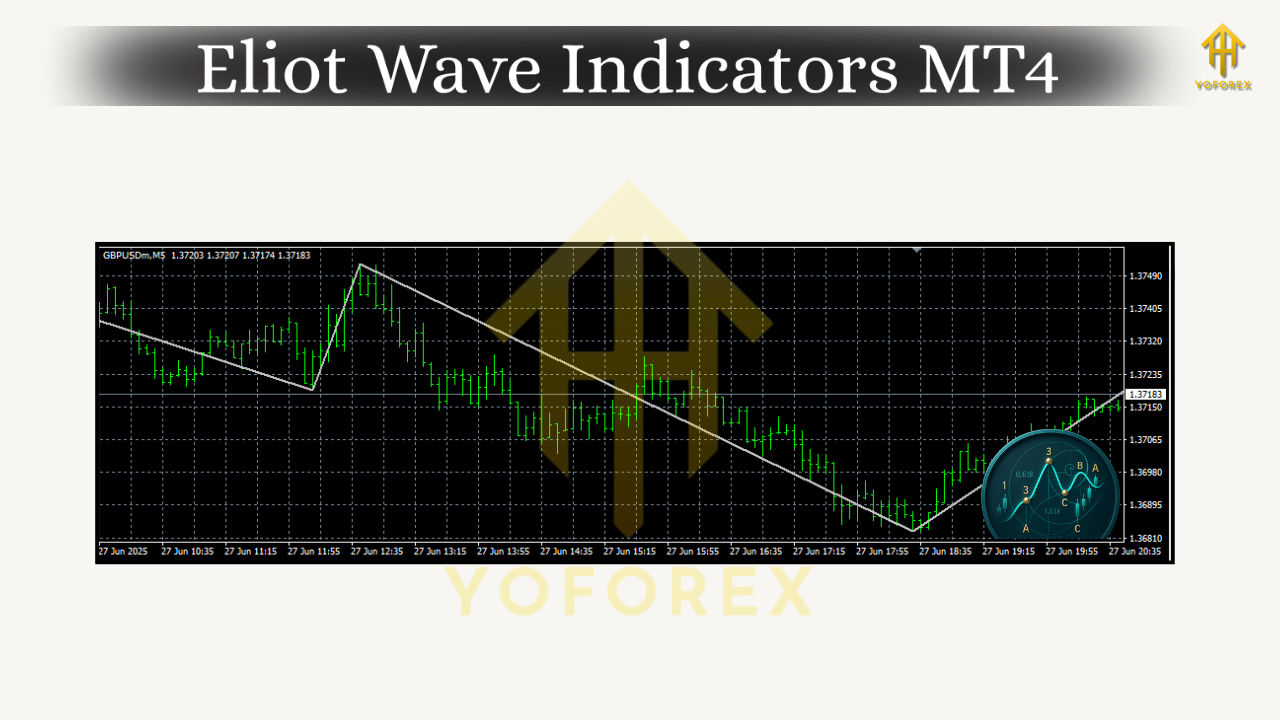
Eliot Wave Indicators MT4 are a collection of scripts that try to plot, label, or at least guide you through Elliott Wave structures directly on your MT4 charts. At a high level, Elliott Wave theory says markets move in a repeating cycle of five-wave impulses (with the main trend) and three-wave corrections (against it). In practice, that means you’ll see pushes (1-2-3-4-5) and pullbacks (A-B-C) unfold across timeframes—from M5 scalp action to D1 swing moves.
The indicators don’t “predict the future,” and that’s a good thing. Instead, they nudge you toward structure-first thinking: Is this push likely a Wave 3 extension? Are we chopping in a Wave 4 triangle? Is the correction almost done around a Fib cluster? By translating those questions into clear chart cues—labels, projected zones, and pattern hints—you get a roadmap. You still manage risk; the tool just helps you pick the battles worth fighting.
A lot of traders give up on waves because manual labeling can be exhausting. Eliot Wave Indicators MT4 reduce that friction. Even if you tweak labels manually (totally normal), the auto-spotting gets you 80% there, faster. That alone can be the difference between forcing trades and waiting for the clean setup.
How Elliott Wave Works (Quick Primer)
- Impulse (1-2-3-4-5): Trend-pushing sequence where Wave 3 is often the longest, Wave 4 usually alternates in character vs. Wave 2 (sharp vs. sideways), and Wave 5 caps the move—sometimes with divergence.
- Correction (A-B-C): Countertrend cleanup. Can be sharp (zigzag), sideways (flat), or choppy (triangle/combination).
- Fractals: Waves nest. A Wave 3 on M15 might be just a tiny part of a bigger Wave 1 on H4. Timeframe alignment matters.
- Fibonacci: Not magic—just common retracement/extension clusters (38.2%, 50%, 61.8%, 100%, 161.8%) where crowds act.
Understanding those basics makes the indicator signals click faster.
Key Features
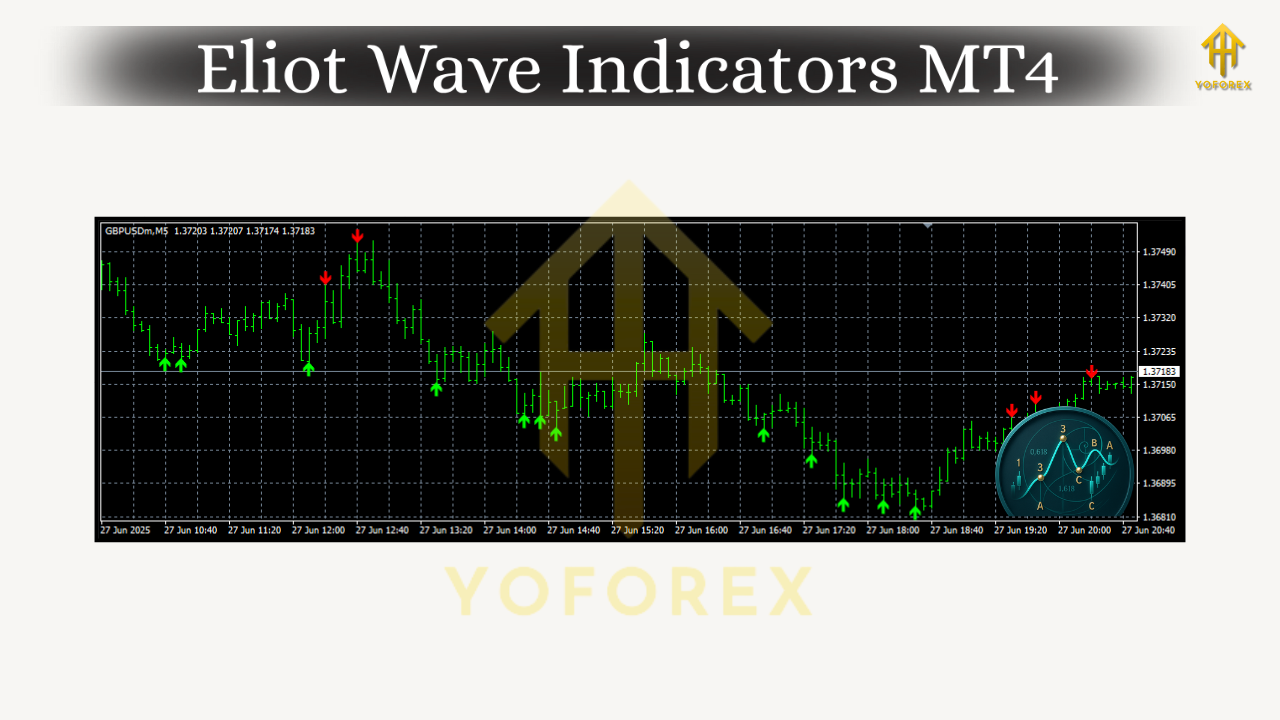
• +Auto/assisted wave labeling for impulse (1-5) and corrective (A-B-C) legs
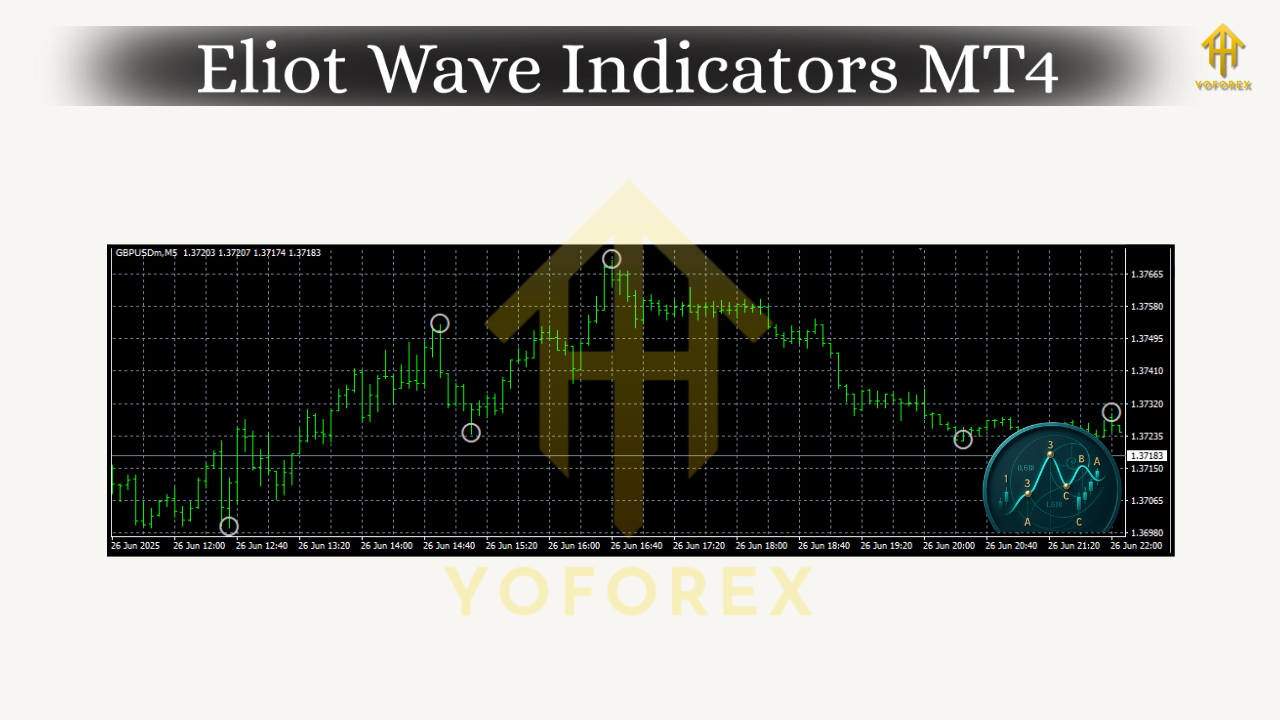
• Smart swing detection that adapts to timeframe volatility
• Fibonacci retracement/extension overlays for confluence zones
• Projection boxes for potential Wave 3/5 targets and Wave C endpoints
• Real-time invalidation alerts (e.g., if Wave 4 enters Wave 1 territory in standard structures)
• Multiple timeframes in one view (top-down alignment hints)
• Divergence companion cues (RSI/MACD hooks near Wave 5)
• Clean on-chart cheat-sheets (rules & guidelines, so you don’t forget mid-trade)
• Template-ready profiles for scalping, day trading, or swing setups
• Lightweight coding for smooth MT4 performance, even on lower-end PCs
• Optional risk box visualizer (entry, SL, TP proportions at a glance)
• Exportable screenshots for journaling and post-trade review
Trade Setups That Actually Make Sense
1) Wave-3 Breakout (Bread-and-Butter)
- Idea: Enter as Wave 3 kicks off after a shallow Wave-2 pullback.
- Execution: Mark the Wave-1 high/low. When price breaks the Wave-1 extreme after a 38.2–61.8% Wave-2 retrace, trigger.
- Stops: Under the Wave-2 low (for a buy) or above the Wave-2 high (for a sell).
- Targets: 161.8% extension of Wave-1 (conservative), 261.8% (aggressive).
2) Wave-4 Pullback to Structure
- Idea: Join the trend after the fast Wave-3 move, during a sideways Wave-4.
- Execution: Look for alternation (if Wave-2 was sharp, Wave-4 is likely sideways). Confluence with 23.6–38.2% retrace + prior structure.
- Stops/Targets: SL beyond the Wave-4 invalidation; aim for a clean Wave-5 push to prior swing extension.
3) End-of-Wave-5 Divergence Fade (Advanced)
- Idea: Countertrend scalp when price prints a marginal new high/low but momentum lags.
- Execution: Wait for RSI/MACD divergence plus a micro 1-2 breakdown against the Wave-5 direction.
- Risk: This is trickier—keep size small and get paid quickly; don’t overstay.
4) ABC Completion with Fib Cluster
- Idea: Trade the end of a correction (C leg) back into the main trend.
- Execution: Align A= C symmetry, 100–161.8% extension, and a prior demand/supply zone.
- Stops: Just beyond the C-leg extreme.
- Targets: First target back to the start of A; runners for the new impulse.
Installation & Configuration (MT4)
- Download & Copy: Place the Eliot Wave Indicators MT4 files into
MQL4/Indicatorsinside your MT4 data folder. - Restart MT4: Or hit Refresh in the Navigator panel.
- Attach to Chart: Right-click the indicator → Attach to a chart for your pair/timeframe.
- Set Sensitivity:
- Swing sensitivity: Higher for noisy pairs/timeframes (e.g., XAUUSD on M5).
- Label strictness: Start moderate; increase once you’re comfortable with the rules.
5. Turn On Confluence: Enable Fib and divergence overlays if you like visual cues.
6. Save as Template: So you can apply the same setup with two clicks across pairs.
Pro tip: Work top-down. Mark the dominant wave path on H4/H1, then zoom to M15/M5 for precise entries aligned with the bigger picture. It’s boring… and it works.
Practical Tips (That Save Accounts)
- Risk first: 0.5–1% per trade is plenty, especially if you plan to stack positions within a single impulse.
- Don’t force labels: If two counts are equally valid, let price choose. Trade the levels, not the label ego.
- Wait for confirmation: Especially on Wave-3 attempts; let the break hold above Wave-1 high with a clean candle close.
- Use timing windows: London open, NY overlap—impulses love liquidity.
- Journal with screenshots: Each wave session improves your eye; journaling compounds that learning.
- Accept alternates: Sometimes your Wave-3 dream is just a complex B wave. Happens. Manage it, move on.
Common Mistakes to Avoid
- Chasing late Wave-5s: The risk-reward degrades quickly; look for divergence before fading or skip it.
- Ignoring invalidation rules: If a rule breaks, exit. “Maybe it comes back” is not a plan.
- One-timeframe tunnel vision: A pretty M5 count can be rubble against an H4 correction. Always align.
- Maxing indicator complexity: Keep it readable—too many overlays = decision fatigue.
Why It’s Worth Your Time
You don’t need mystical forecasting to trade better. You need a repeatable framework. Eliot Wave Indicators MT4 give you that: a simple way to see if you’re pushing with the tide or paddling against it. If you stick to invalidation points, favor Wave-3/4 setups, and demand confluence, your trades get cleaner. Not perfect—just cleaner. And that consistency is what nudges outcomes from random to respectable.
If you need help getting started or want a nudge on settings, YoForex’s team is known for straight answers and practical tweaks (no fluff, no jargon). Ping us and we’ll point you right.
Support & Disclaimer
Need assistance installing or tuning Eliot Wave Indicators MT4? Message us anytime: WhatsApp: https://wa.me/+443300272265 or Telegram: https://t.me/yoforexrobot. We’ll help you pick sensible defaults for your pair/timeframe and share a couple of starter templates.
Disclaimer: Trading involves risk. Past performance is not a guarantee of future results. Always test on demo before going live, and never risk money you can’t afford to lose. This content is educational; you’re responsible for your trading decisions.
Call to Action
Ready to see structure where others see noise? Add Eliot Wave Indicators MT4 to your charts, start with one or two bread-and-butter setups, and journal ten trades. You’ll feel the difference—less guessing, more planning. Grab the indicator, set your rules, and trade the plan.



Comments (0)
No comments yet. Be the first to comment!
Leave a Comment