
Parasite EA V5.4 MT5 — Ride Institutional Momentum On USDJPY & US500
Tired of chasing price only to watch it reverse the second you enter? Parasite EA V5.4 for MetaTrader 5 is built for exactly that pain. It’s an AI-driven Expert Advisor designed to detect and mirror the trading behavior of institutions and large banks—the players most retail traders try (and fail) to follow. Instead of guessing, Parasite EA looks for footprints: sudden order-flow bursts, velocity changes, and liquidity grabs. When conditions align, it executes with speed, aims for asymmetric reward, and keeps risk tight.
In this guide, you’ll get a clear, practical walkthrough of how Parasite EA V5.4 MT5 works, the instruments and timeframes it targets, how to install it, and a set of battle-tested setup ideas you can adapt. We’ll also cover risk controls and realistic expectations—coz that’s what protects accounts over the long haul.
What Is Parasite EA V5.4 MT5?
Parasite EA V5.4 MT5 is an automated trading system powered by modern AI logic. Its core idea: scan the market for signs of large, coordinated orders, then align entries with that flow instead of fighting it. When institutions push price through resting liquidity—think stop clusters at session highs/lows—the move often extends farther than most expect. Parasite attempts to “parasite” onto this motion with structured entries, measured stops, and exit logic tuned to momentum decay.
Timeframes: M5 to M30
Pairs/Indices: USDJPY and US500 (S&P 500 index CFDs)
Style: Momentum/flow-following with liquidity-sweep awareness
Rather than relying on a single indicator, Parasite blends signals: short-term volatility spikes, tick-velocity shifts, and microstructure clues (e.g., breaks of liquidity pools or session highs/lows). The goal isn’t magical prediction; it’s probability stacking—only acting when multiple conditions point in the same direction.
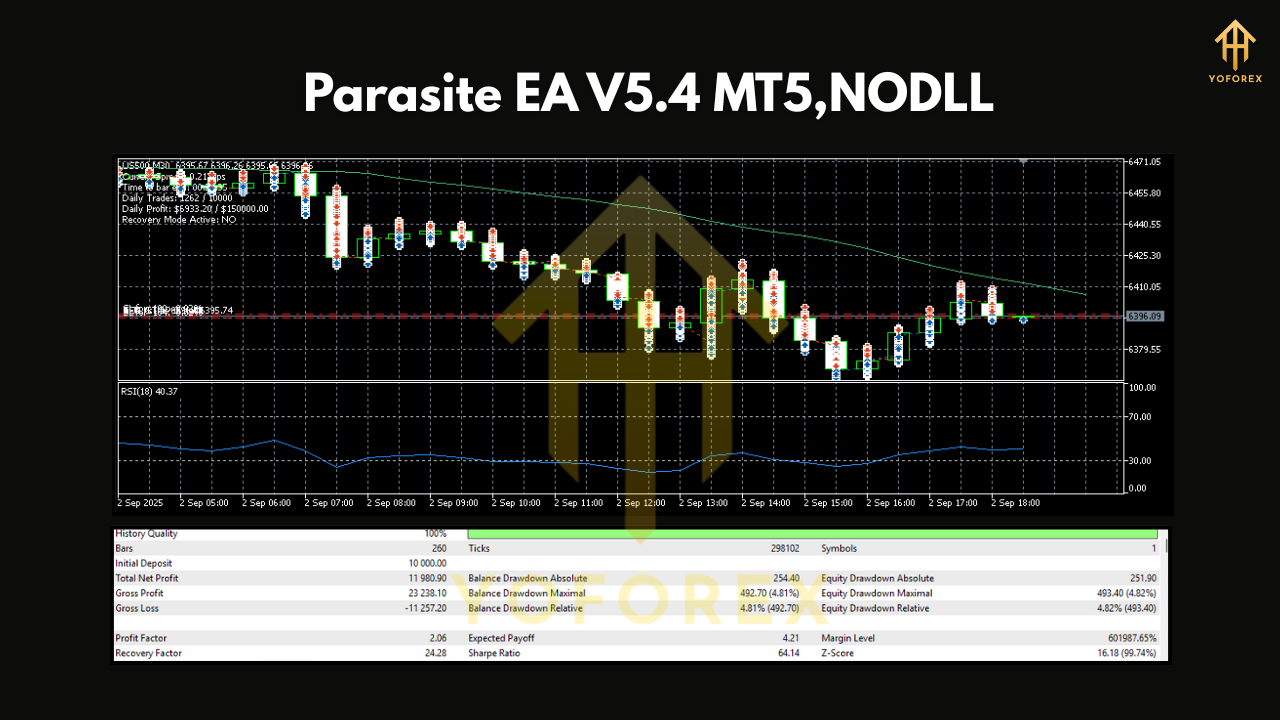
Why USDJPY and US500?
- USDJPY often exhibits clean momentum bursts during Tokyo and London sessions, making it suitable for M5–M30 flow strategies. It reacts quickly to rate-sensitive headlines and BOJ chatter, which can produce the sharp moves Parasite seeks.
- US500 (S&P 500) is deep and liquid, with strong participation at the New York open and during macro news. That liquidity means big footprints are easier to detect; when volume accelerates and liquidity thins at key levels, impulses can be powerful.
Both markets are popular with prop-firm traders and retail alike, but do note: index trading hours, contract specs, and spreads vary by broker. Always match your settings to your broker’s symbol (US500, US500.cash, SPX500, etc.) and trading hours.
How Parasite EA V5.4 MT5 Approaches the Market
1) Institutional Footprint Detection
The EA looks for rapid order-flow changes—velocity shifts, micro breakouts through known liquidity pools, and expansion after “stop runs.” It doesn’t need perfect volume; it uses proxies like tick activity and volatility expansion to infer interest.
2) Confirmation & Filters
To avoid fakes, Parasite stacks conditions: session filters (e.g., Tokyo/London/NY), volatility thresholds, and optional “no-trade” windows around major news. The idea is to trade fewer but higher-quality impulses.
3) Risk-First Entries
Entries are planned so that initial stop-loss sits beyond a logical invalidation point—e.g., beyond the sweep level or an ATR-based buffer. If price snaps back immediately, the loss is controlled; if momentum continues, the EA can scale out or trail.
4) Adaptive Exits
Exits are not one-size-fits-all. Parasite can use partial take-profits, time-based exits when momentum fades, and trailing stops. On M5 it may trail tighter; on M30, it can give positions more breathing room.
5) No Martingale Required
The strategy does not require martingale or grid to function. You can keep risk consistent per trade (e.g., 0.5%–1.5%) and let statistics work in your favor. If you’re tempted to “chase losses,” don’t—stick to a fixed risk model.
Recommended Setup (M5–M30)
Broker/Execution
- ECN or Raw-spread account recommended.
- Tight spreads and fast execution help on M5.
- A reliable VPS (low latency) strongly advised, especially for US500 at NY open.
Risk & Money Management
- Start small: 0.5%–1% per trade on early runs.
- Use hard SL always; avoid widening stops arbitrarily.
- Consider a daily loss cap (e.g., 2%–3%); when hit, stop trading for the day.
Session Windows
- USDJPY: Tokyo open to mid-Tokyo; London open to first two hours of London.
- US500: 30 minutes before NY cash open to ~2 hours after open.
Adjust to your broker’s time and volatility. Avoid low-liquidity fringes.
News Awareness
- For high-impact releases (FOMC, CPI, NFP), either reduce lots, increase SL buffers, or pause trading around the announcement window. Parasite thrives on flow, but news whipsaws can be brutal.
Starter Parameter Ideas (Customize to Your Broker)
These are starting points—not promises. Always forward-test on demo.
USDJPY M15
- Stop-Loss: 1.2 × ATR(14)
- Take-Profit: 2.0 × risk (risk:reward ~1:2)
- Trailing: Enable after +1.2R, step trailing every minor structure break
- Filters: Trade Tokyo & London only; skip 5 minutes pre/post high-impact JPY/USD news
US500 M5
- Stop-Loss: 0.8 × ATR(14) (M5 moves fast; keep SL disciplined)
- Take-Profit: Scale out 50% at +1R, trail the rest behind last swing low/high
- Filters: Trade NY open window; disable during extremely wide spreads or news spikes
These frameworks aim to capture the meat of the move while avoiding death by chop. If you see too many scratch trades, widen filters or move up to M15/M30.
Backtesting & Forward-Testing Tips
- Use tick data with variable spreads for best realism.
- Model commission and realistic slippage, especially for US500.
- Assess session-specific performance (don’t average day and night).
- Evaluate a distribution of outcomes (max adverse excursion, win streaks/loss streaks) rather than fixating on headline profit.
- After backtests, do a 4–6 week forward demo to ensure results translate with your broker’s conditions.
- Keep a journal: track which sessions/time windows produce outliers—lean into what’s consistently working.
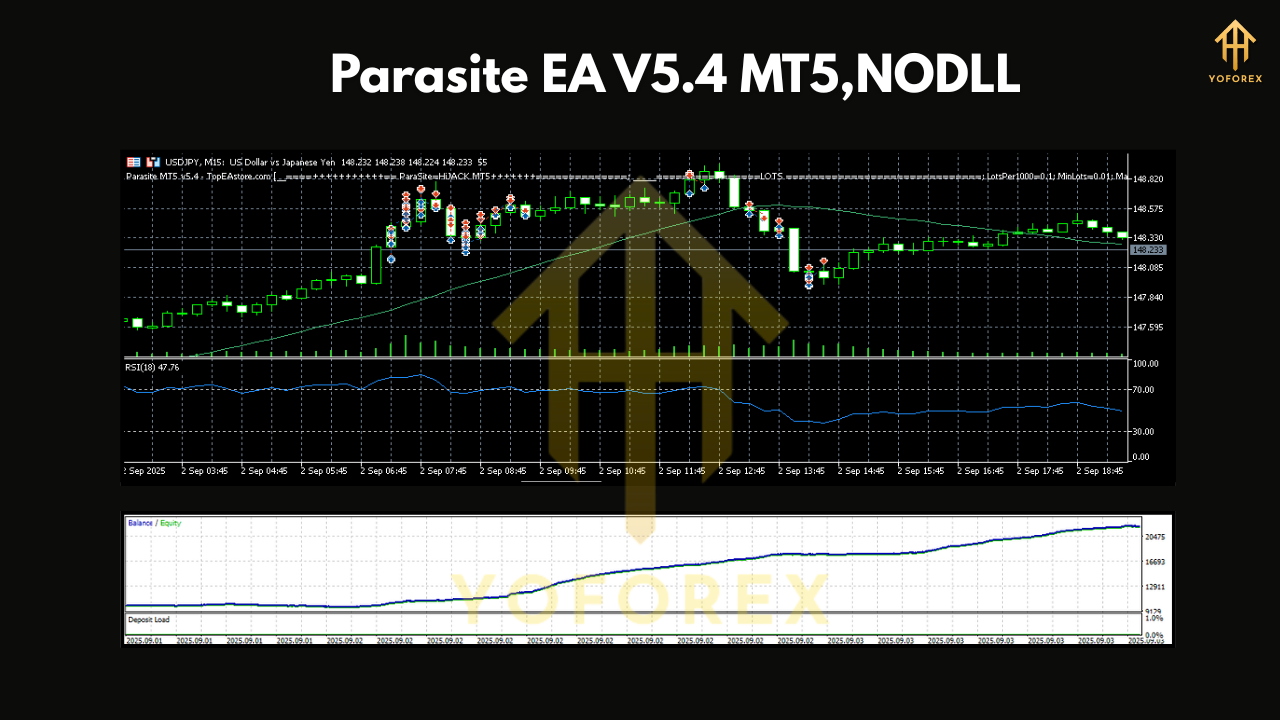
Who Is Parasite EA For?
- Momentum-friendly traders who prefer defined risk and asymmetric payoff.
- Prop-firm candidates who must respect daily drawdown rules (set hard limits; no martingale).
- Busy traders who can’t watch charts all day but can check in around key sessions.
- System tinkerers who like to optimize around broker, spread, and session specifics.
If you prefer deep mean-reversion or grid-based income, this isn’t it. Parasite wants moves, not ranges.
Risk, Drawdowns, and Expectations
Let’s keep it real. Even with clever AI logic, no EA wins all the time. Flow-following systems can take clusters of small losses in chop, then make it back (and more) when the market trends or runs stops. That means your risk limits and patience matter as much as the settings.
- Expect losing days—cap them and walk away.
- A healthy equity curve rarely goes straight up; it steps and pulls back.
- If volatility collapses, trade fewer windows or move up in timeframe.
- Continually refine filters; markets evolve.
Installation (MT5)
- Download the Parasite EA V5.4 MT5 file.
- Open MT5 → File → Open Data Folder →
MQL5/Experts. - Copy the EA file into
Expertsand restart MT5. - In Navigator, right-click Experts → Refresh.
- Drag Parasite EA V5.4 onto your USDJPY or US500 chart.
- Enable Algo Trading, check “Allow live trading,” and load your preferred preset.
- Start with demo or cent account; confirm execution quality before going live.
Best Practices Cheat-Sheet
- Start on M15 before trying M5; dial in filters first.
- Use fixed % risk; no martingale.
- Set a daily stop and respect it.
- Prefer low-latency VPS for US500.
- Keep news calendar handy; pause for major releases.
- Re-optimize lightly if market regime changes, but avoid overfitting.
Final Thoughts
Parasite EA V5.4 MT5 is for traders who want to systematize the process of riding institutional-style momentum—without turning the account into a casino. If you align sessions, respect risk, and stay patient through the quieter days, the edge comes from catching those sudden, purposeful pushes that leave late entrants scratching their heads.

Comments (0)
No comments yet. Be the first to comment!
Leave a Comment