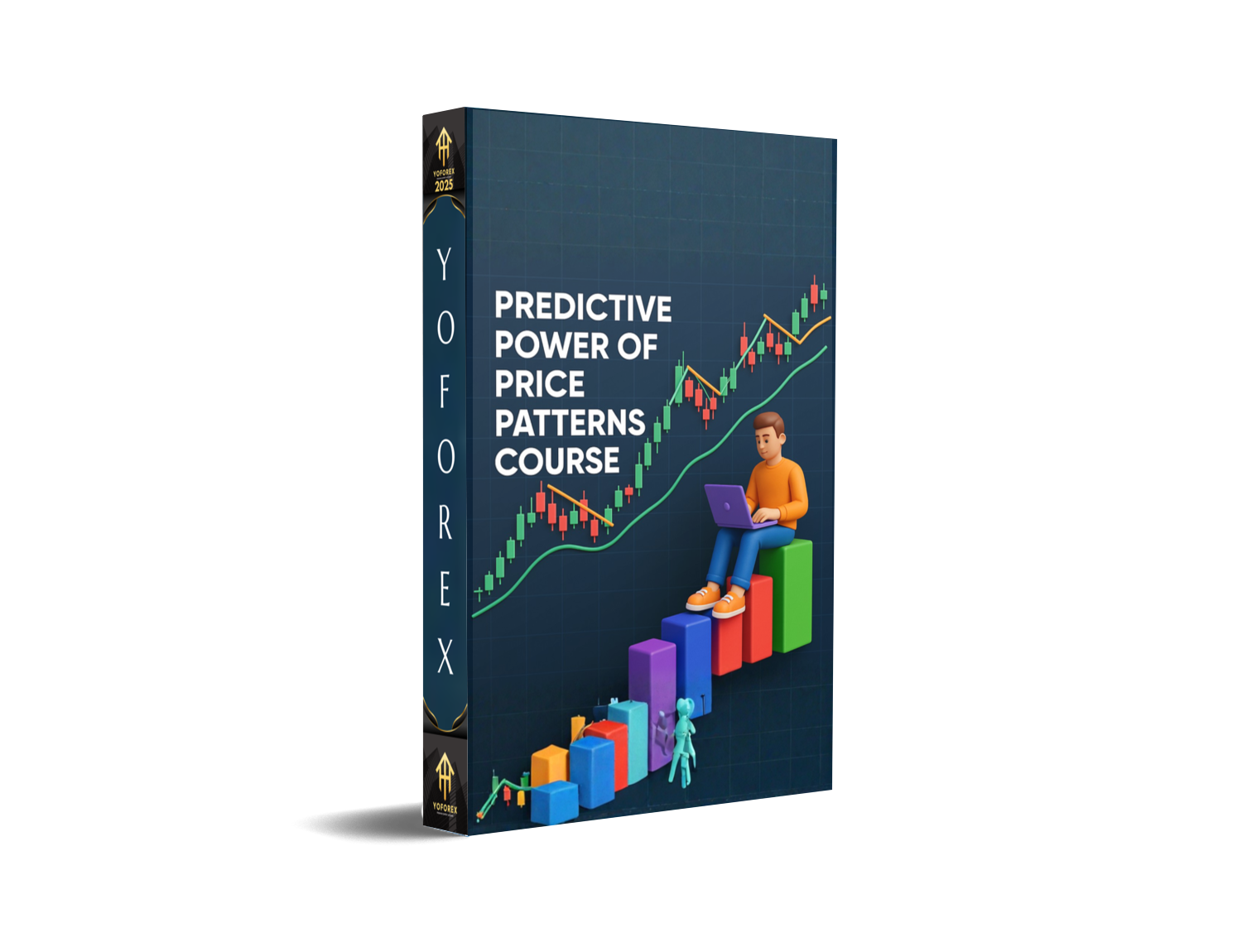
Technical analysis has always lived in a strange tension with academic finance. Traders who live in the markets every day swear by price patterns, candlesticks, breakouts, and chart formations. Meanwhile, academicians continuously question whether such methods hold any true predictive value. The Predictive Power of Price Patterns Course sits right at the center of this debate, offering one of the most structured explorations of how price patterns influence market movements and whether markets truly behave randomly, as suggested by the Efficient Market Hypothesis (EMH).
This blog breaks down the course material, the academic criticisms, the empirical evidence, and what modern research says about the real predictive power behind technical patterns. Whether you're a trader trying to sharpen your strategy or a curious reader trying to understand how price action theories stand against academic scrutiny, this course offers a surprisingly balanced and analytical perspective.
Why the Debate Exists: Traders vs. Academicians
The gulf between practitioners and academicians in finance is almost legendary.
On one side are traders—charting price patterns, recognizing trends, and spotting signals. They operate with practicality, intuition, and decades of market experience. They use colorful pattern names like “head and shoulders,” “hammer,” or “double bottom,” believing these patterns reflect underlying market psychology.
On the other side stand academics—armed with theories like EMH, rigorous statistics, and skepticism. EMH asserts that all publicly available information is already priced in, making consistent predictive trading nearly impossible. Any strategy based purely on publicly visible price data should, according to EMH, be useless once enough traders use it.
This course highlights this divide and explores whether price patterns truly contain exploitable information or whether they are illusions that disappear under statistical testing.
The Core Argument: Do Price Patterns Predict Future Prices?
The Predictive Power of Price Patterns Course begins by showing how technical analysts categorize patterns to predict future price movements. They look for visual cues that reflect supply–demand imbalances or shifts in trader behavior.
However, critics argue:
- Price patterns rely on easily observable information.
- If they worked, everyone would use them.
- Once widely used, the patterns should self-destruct.
- Without clear statistical validation, trends may be illusions.
The course systematically breaks down these criticisms and presents research examining whether patterns genuinely affect probabilities of future price direction.
Efficient Market Hypothesis vs. Real-World Market Behavior
EMH states that no one can consistently outperform the market using public information. But several experiments challenge this idea.
For example, studies like Beard and Beil (1994) show that traders often act based on what others might do—even when it means taking smaller, certain returns over uncertain, larger ones. The course argues that price action reflects collective human behavior, not just random noise.
And if traders are influenced by the perceived actions of other traders, then price patterns may actually capture repeatable behaviors.
This makes the course’s exploration especially interesting:
Are markets purely efficient, or do they contain structurally predictable elements?
Statistical Evidence Examined in the Course
The course goes deep into the statistical side of technical analysis.
1. Autoregressive Models and EMH Testing
A standard test for market efficiency checks whether past returns help predict future returns.
If coefficients in an autoregressive model do not significantly differ from zero, EMH appears valid.
White (1993) famously showed that neural networks failed to find significant predictive structure in IBM stock returns.
But other findings contradict that:
- Caginalp and Constantine (1995) found strong momentum effects when removing exogenous random influences.
- Some assets appear more predictable once broader market noise is filtered out.
This opens the door for pattern-based prediction to have merit under certain conditions.
Why Many Pattern Studies Fail—and How This Course Avoids Those Pitfalls
Traditional chart pattern studies face two big challenges:
- Imprecise pattern definitions
Many chart patterns—triangles, head-and-shoulders, channels—vary widely in interpretation. - Patterns requiring long timeframes
Long-form patterns (6 weeks, 12 weeks, etc.) get distorted by external events.
The Predictive Power of Price Patterns Course resolves these issues by focusing on:
- Short-term indicators
- Precisely defined patterns
- Japanese candlestick structures
This makes statistical testing far more feasible and objective.
Why Candlestick Patterns?
Candlestick patterns solve several problems:
- They have clear definitions (hammer, engulfing, doji, etc.).
- They operate on fixed time intervals, making statistical comparisons easier.
- They have been in use for centuries—raising the question: why haven’t they become obsolete?
Because candlestick patterns reflect trader psychology, the course argues they may persist even under heavy usage.
Nonparametric Testing Used in the Course
Instead of relying on assumption-heavy models, this course uses nonparametric tests—meaning:
- No assumptions about probability distributions
- No need for linear structures
- More robustness against market noise
- Purely data-driven pattern evaluation
This allows the course to explore questions like:
- Does a bullish engulfing pattern increase the probability of upward movement?
- Does a shooting star reliably signal a reversal?
- Can trading solely on candlestick signals be profitable?
The course presents mixed yet meaningful results—some patterns show strong predictive validity, while others do not.
Does Trading on These Patterns Make Money?
The course doesn’t just stop at direction prediction.
It also examines:
- Profitability of pattern-based strategies
- Win/loss ratios
- Expected returns after pattern signals
- Pattern performance across different timeframes
The results reveal that while not all candlestick patterns deliver profitability, several do show statistically meaningful tendencies—especially when combined with trend filters or volume confirmation.
Implications for Traders and Market Theory
A major takeaway from the course is this:
Price patterns cannot be dismissed as random noise.
If some patterns reliably change the probability of future price direction, then:
- EMH does not hold universally.
- Market participants behave in predictable ways.
- Visually defined structures can capture real psychological phenomena.
- Certain strategies may remain effective even if widely known.
The course underscores that markets may contain deterministic behaviors layered beneath randomness.
Conclusion
The Predictive Power of Price Patterns Course bridges a long-standing gap between practical traders and financial theorists. By focusing on statistically testable, precisely defined patterns—especially Japanese candlesticks—it offers a clearer understanding of whether markets truly contain predictable structures.
It doesn’t claim that all technical analysis works. Instead, it provides:
- A scientific framework
- Clear definitions
- Statistical testing
- Practical implications
This makes it one of the most balanced explorations of price patterns and market predictability.
For any trader aiming to understand whether chart patterns truly hold weight, this course provides clarity, evidence, and a fresh perspective rooted in both mathematical rigor and market psychology.



Comments (0)
No comments yet. Be the first to comment!
Leave a Comment