
Among MT5 Expert Advisors, the standouts are rarely the ones that claim to work on every pair and every timeframe. The strongest contenders tend to focus on one symbol’s micro-structure and build rules that genuinely fit that market. Prodigy FX EA V9.105 (MT5) follows that philosophy. It targets CAD/CHF and blends Bollinger-band context with a controlled averaging methodology and adaptive per-position exits. This combination aims to exploit the pair’s frequent range phases while applying rules to cope with the inevitable directional bursts. This review explains how the logic fits CAD/CHF, what you should do to deploy it cleanly, and which risk controls keep the strategy robust through changing market regimes.
How Prodigy FX EA Approaches CAD/CHF
CAD/CHF often trades in compact ranges punctuated by occasional trend legs driven by oil sensitivity (CAD), global risk sentiment, and SNB-related tone (CHF). In that environment, the idea of fading extremes and re-centring toward the mean can work—provided the system understands volatility and doesn’t overstay during real breakouts. Prodigy FX EA uses Bollinger Bands (a moving-average centerline with standard-deviation envelopes) to detect when the price has pushed unusually far from its recent mean. When conditions align, it opens a position and, if the move extends further, may add layers to improve the blended entry. Critically, it doesn’t rely on a single “one-size-fits-all” exit; instead, it assigns adaptive take-profit and stop-loss per position, so each layer has its own outcome path based on the prevailing context.
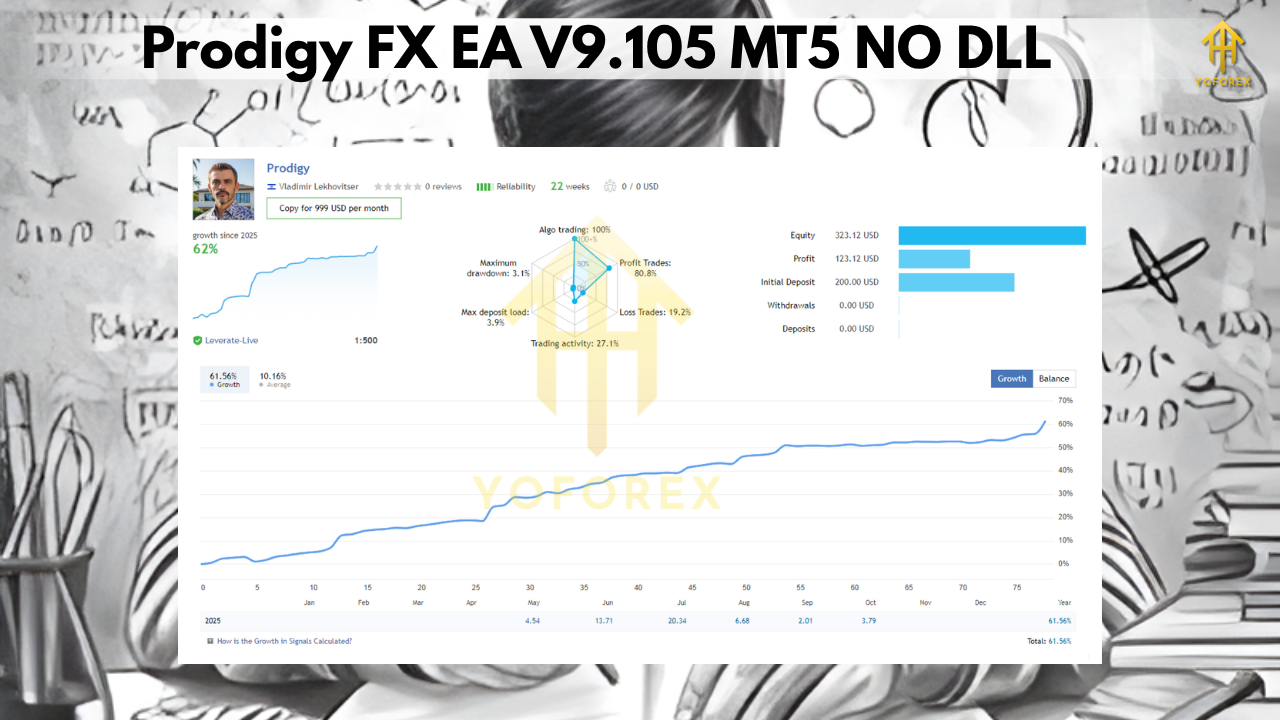
Why Bollinger Bands Matter Here?
Bollinger Bands do two useful things for mean-reversion systems:
- They scale with volatility—bands widen when markets are active and tighten during consolidation—so the definition of “stretched” adapts to conditions instead of being a fixed pip distance that quickly becomes stale.
- They frame probabilities visually—touches or pushes beyond outer bands often coincide with statistically unusual distances from the average, which is where some of the best fade and reversion opportunities appear. For a strategy like Prodigy FX, this adaptivity aligns with the idea of graduated entries and context-aware exits.
Averaging, Not Unlimited Doubling
Averaging is a loaded word because it’s frequently confused with the reckless martingale. Prodigy FX EA’s premise is structured layering: add exposure only within set rules, while using per-position stop-losses and tiered take-profit targets that seek to normalise risk and accelerate partial exits as price snaps back. That said, any averaging system is inherently path-dependent—your risk plan must cap the number of layers and define how much equity you are willing to expose during adverse moves. The edge lives in discipline: when to pause, when to reduce size, and when not to add.
Recommended Deployment Setup (MT5)
- Symbol & Chart: Use CAD/CHF. The EA’s logic is internally timed, so it does not depend on a specific visible timeframe.
- Environment: Favour a Standard (spread-only) account profile if possible. Because averaging increases trade count, commission-heavy cost models can deteriorate the expectancy of tight, layered exits.
- Risk Baseline: Start with conservative lot sizing. Pre-declare a maximum number of layers and a maximum net exposure the EA may reach.
- Hosting: If you intend to run the EA continuously, place MT5 on reliable hosting (or a VPS) with low latency.
- Data & Slippage Checks: Track average spread, realised vs. quoted slippage, and trade duration during your first weeks. If costs creep higher than assumed, adjust sizing or guardrails.
Risk-First Operating Playbook
To keep a mean-reversion engine healthy across regimes, put these rules in writing before you go live:
- Max Layers: Hard cap the number of additional entries. No exceptions.
- Daily Loss & Equity Guards: Stop new entries if daily loss hits your threshold or if equity drawdown crosses a pre-set line.
- Event Filters: Around BoC decisions, SNB commentary, and high-impact CPI or employment releases, either reduce risk or pause openings for a time window before and after the event.
- Session Hygiene: Avoid fresh layering at rollover and during thin liquidity when spreads widen.
- Weekly Review: Assess profit factor, median trade length, MAE/MFE by layer, realised spread, and hit rate relative to expectations. Adjust lot steps and exposure caps based on evidence—not emotion.
Validation Workflow (Before Real Scaling)
Treat backtests as shape indicators, not promises, and combine them with walk-forward and forward testing:
- Replication Backtest: Reproduce the vendor’s stated assumptions as closely as your tester allows (CAD/CHF, realistic Standard-style costs). You’re checking that the qualitative behaviour—trade rhythm, exposure laddering, typical targets—makes sense.
- Walk-Forward: Use rolling windows to ensure the logic stays sensible without perpetual re-optimisation. You want consistency, not perfect curves.
- Monte Carlo Stress: Randomise trade order or volatility patches to reveal path sensitivity. Averaging systems should remain survivable even when the sequence of wins and losses turns unfavourable.
- Forward Test (Demo or Micro-Live): Run several weeks with tiny lots. Only scale after confirming that execution quality (spreads, slippage, fill latency) matches your assumptions.
Strengths You Can Leverage
- Single-Pair Specialisation: Designing for CAD/CHF helps the rule-set mirror the pair’s real behavior instead of diluting logic across mismatched symbols.
- Volatility-Adaptive Signals: Bollinger logic naturally flexes in active vs. quiet sessions, improving the relevance of “overextended” signals.
- Per-Position Exits: Adaptive TP/SL per layer reduces the “all or nothing” problem and can smooth equity curves during noisy consolidations.
- Recent-Era Design Intent: Tuning focused on the last few years means the baseline assumptions were shaped by modern market conditions, not just legacy regimes.
Limitations You Must Respect
- Trend Phases Hurt Averaging: Sustained CAD/CHF trends will stress a fade-first system. That’s why strict layer caps and event filtering matter.
- Broker Cost Drift: If spreads widen or commissions change, tight targets may no longer clear costs. Monitor and re-validate regularly.
- Execution Variance: Slippage and latency can alter the realised entry ladder; keep your platform stable and your hosting close.
Frequently Asked Questions
Do I need a specific timeframe?
No. The EA manages its own internal timing and logic. Attach it to CAD/CHF and let it operate.
Is this a martingale?
No. It’s averaging with predefined limits and adaptive exits, not an unlimited multiplier. You still need firm guardrails.
Can I run it on Raw/ECN?
You can, but understand the commission effect. If your exit targets are tight, per-trade commissions may erode expected returns faster than a spread-only model.
How big should my first position be?
Small. Start with conservative risk and only scale sizing after data confirms acceptable drawdown profiles, slippage, and costs in your environment.
Editorial Verdict
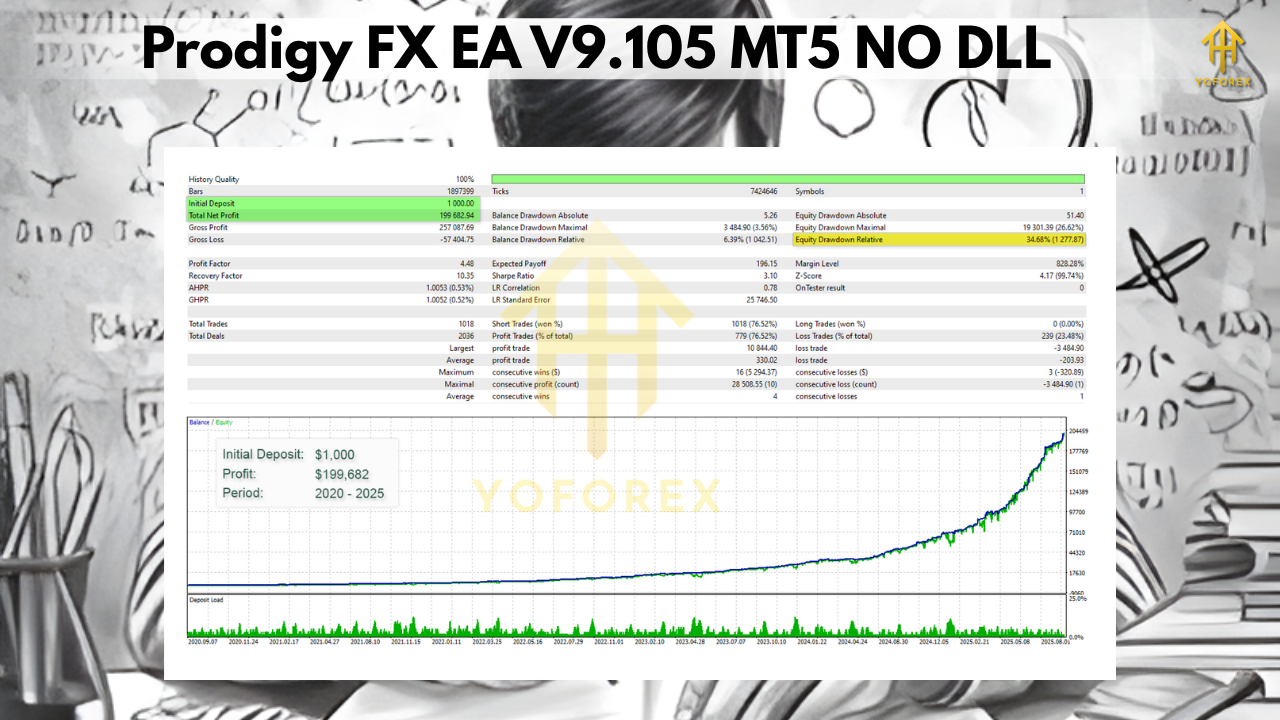
Prodigy FX EA V9.105 (MT5) is deliberately narrow: one pair, a well-known volatility framework, and a controlled averaging scheme that prioritises adaptive risk management. That design choice is a strength for traders who prefer clarity over complexity. If you mirror the intended environment, enforce hard limits, and validate with a structured workflow, Prodigy FX can serve as a specialised CAD/CHF component in a diversified MT5 lineup. Its success in your account will come down to process: respect the guardrails, adapt to cost changes, and pause when the market’s character flips from range to relentless trend.






Comments (0)
No comments yet. Be the first to comment!
Leave a Comment