SwingTrade Candle Patterns EA V1.0 MT4 – RSI + ATR Powered Swing Entries
Swing trading doesn’t have to be a guessing game. If you’ve ever entered a clean-looking setup only to see it fail a few candles later, you know the pain of mixed signals and late entries. SwingTrade Candle Patterns EA V1.0 (MT4) is designed to cut that noise. It combines proven candlestick reversal structures—Pin Bar, Engulfing, Morning/Evening Star, and Hammer—with RSI confirmation and ATR-based money management to produce steady, lower-drawdown performance on higher timeframes. It’s built for disciplined swing trading, and yes, it’s valid for prop firms when used with sensible risk.
Pairs: EURUSD, GBPUSD, AUDUSD, USDJPY
Timeframes: H4 or H1
Minimum Deposit: $500
Why this EA?
Swing trading succeeds when entries are aligned with higher-timeframe structure and risk is sized realistically for volatility. This EA focuses on clarity and restraint:
- Entries only trigger on established reversal patterns.
- A momentum/mean-reversion check via RSI filters out low-quality signals.
- ATR-based position sizing and stops adjust to current volatility, helping avoid over-sizing in fast markets and under-sizing in slow ones.
The result is a rules-driven approach that aims for cleaner entries, consistent risk, and lower equity swings than typical indicator mashups or grid/martingale tactics.
Strategy Logic
1) Candlestick Pattern Engine
The EA scans each symbol/timeframe for high-probability reversal structures:
- Pin Bar / Hammer: Long wick rejection at key levels hinting exhaustion.
- Engulfing (Bullish/Bearish): Body of the signal candle fully engulfs the prior candle, signaling a decisive shift.
- Morning/Evening Star: Classic three-candle reversal formation capturing momentum hand-off.
By focusing on these four well-researched patterns, the EA avoids over-fitting and remains adaptable across market regimes.
2) RSI Confirmation
Patterns alone can be deceptive in trending markets. The RSI filter adds a probabilistic layer so that long signals align with recovering momentum and short signals align with waning momentum. This reduces false starts and late entries, especially on H1/H4 where noise can still creep in around session opens.
3) ATR-Based Money Management
ATR (Average True Range) is the engine for both stop placement and lot sizing:
- Stops/Targets: The EA derives a baseline stop distance from a multiple of ATR, then seeks a balanced reward target (for example, 1.5R–2R depending on your settings).
- Lot Sizing: Position size scales relative to the ATR-derived stop, targeting a fixed % risk per trade (e.g., 0.5%–2%). This means the same account risk regardless of whether markets are calm or wild.
4) Trade Management
Because this is swing-oriented, average trade duration can span several candles (sometimes days on H4). The ATR framework supports optional trailing techniques and breakeven logic (if you choose to enable them), letting profits run when momentum extends while protecting downside.
No Martingale. No Grid.
The EA relies on single-position swing entries, not cost-averaging. That’s a major reason its profile fits prop firm rules better than many “fast growth” EAs.
Supported Pairs & Timeframes
- Pairs: EURUSD, GBPUSD, AUDUSD, USDJPY
These four pairs offer healthy liquidity and cleaner pattern structure historically, which suits candlestick-pattern logic and ATR control. - Timeframes: H4 (primary), H1 (secondary)
H4 tends to deliver the best signal quality and lowest noise. H1 offers more frequency but may require tighter filters and slightly more conservative risk.
Tip: If you’re starting fresh or trading under strict prop rules, begin with H4 to learn the EA’s rhythm and equity curve behavior before adding H1 for more opportunities.
Risk Profile & Prop-Firm Readiness
Prop firms typically monitor:
- Max daily loss and overall drawdown
- Consistency of risk per trade
- Prohibited tactics like martingale/grid
This EA’s ATR + percent-risk framework provides a consistent risk footprint that’s easier to keep within firm limits. Since entries are pattern-driven and not stacked aggressively, drawdowns tend to be shallower and more controlled compared with high-frequency scalpers. Combine this with modest per-trade risk (e.g., 0.5%–1%) and you’re positioned to navigate most prop dashboards comfortably.
Practical Performance Perspective
Because market conditions vary, here’s what you can expect qualitatively when the EA is used as intended:
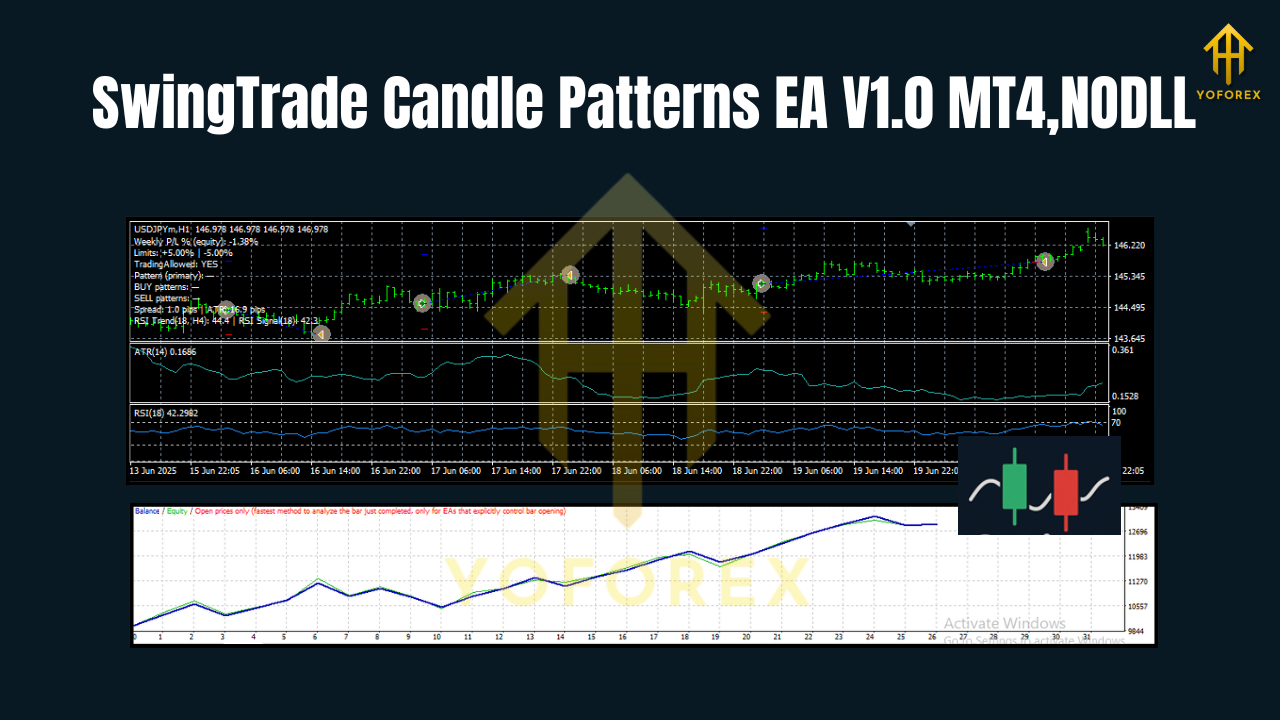
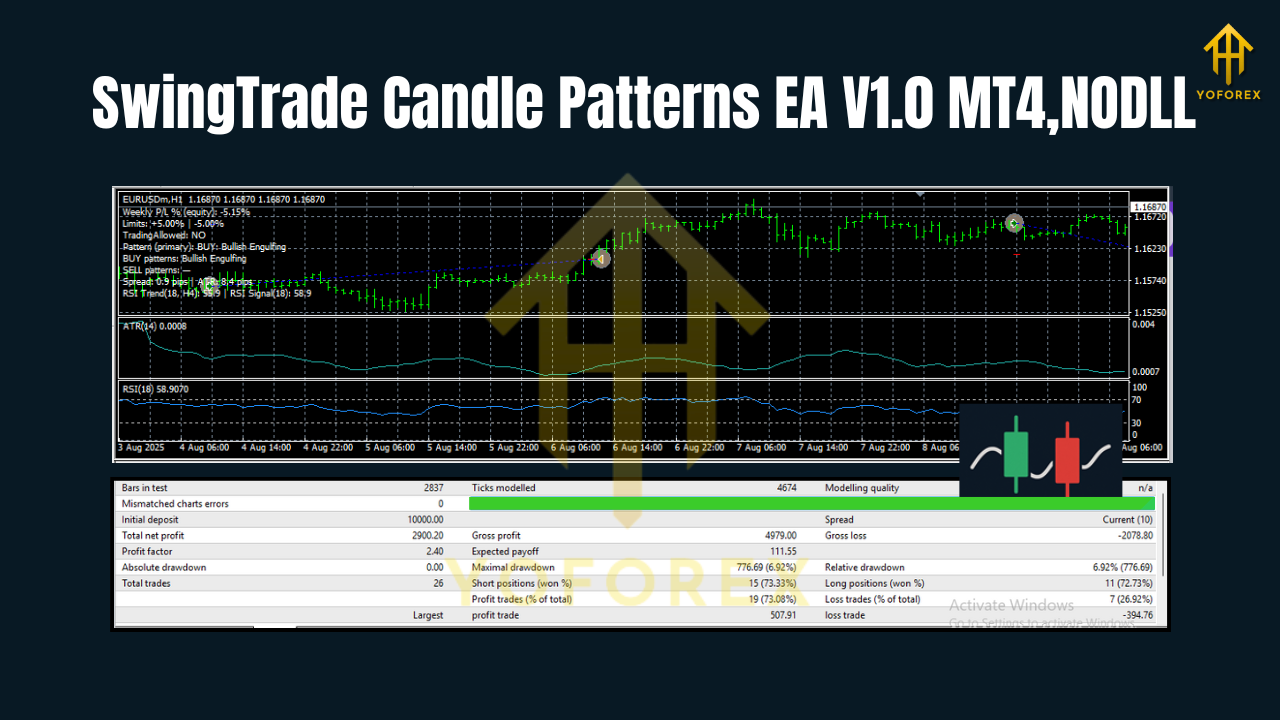
- Steady Equity Growth on Calm-to-Moderate Volatility: RSI-confirmed reversals on H4/H1 often catch the swing legs cleanly.
- Controlled Drawdowns in Choppy Regimes: ATR-sized stops and restrained risk help keep equity dips moderate.
- Lower Trade Count, Higher Quality: This isn’t a 100-trades-per-day robot. It’s designed to be selective; when it trades, it aims for clear edge.
For your own due diligence:
- Backtest each pair on H4 and H1 with variable spread and a sufficiently long data window (2–5 years).
- Forward test on a demo or small live account for at least 4–8 weeks to confirm execution and slippage patterns with your broker.
- Keep a simple log of: entry pattern type, RSI confirmation state, ATR stop multiple, result (R multiple). This creates a feedback loop you can use for minor parameter refinements.
Installation & Setup (MT4)
- Add the EA to MT4:
- Open MT4 → File → Open Data Folder →
MQL4/Experts→ paste the EA.ex4(or.mq4). - Restart MT4 or refresh the Navigator.
2. Broker & Account:
- Use an ECN/RAW spread account with reliable execution.
- Leverage: Typical 1:100–1:500 is fine; risk per trade is %-based, not lot-based.
3. Attach to Chart:
- Open H4 (recommended) or H1 chart for EURUSD, GBPUSD, AUDUSD, USDJPY.
- Drag the EA from the Navigator onto the chart.
- Check “Allow live trading” and “Allow DLL imports” (if required).
4. Core Inputs to Review:
- Risk per Trade (%): Start conservative (0.5%–1%).
- ATR Period & Multiplier: Defaults usually work well; fine-tune only after testing.
- RSI Filter: Ensure the filter is enabled so entries are not purely pattern-based.
- Max Concurrent Trades / Pair: Keep it at 1 to stay prop-friendly.
5. Run on VPS (Optional but Helpful):
- A stable 24/5 VPS keeps charts and logic online, avoiding missed signals during local PC restarts.
Best-Practice Tips
- Stick to the Plan: Resist the urge to override signals based on lower-timeframe noise or news hype.
- Size for Survival: In prop evaluations, longevity and consistency trump everything. 0.5%–1% per trade is plenty.
- Diversify Across Pairs, Not Settings: Keep settings uniform across the four majors; let the symbols diversify the opportunity set.
- Pause During Major Events (Optional): If your rules allow, you may choose to pause new entries around high-impact events (NFP, CPI, central bank rates) and resume afterward.
- Review Monthly: Don’t tinker daily. Evaluate win rate, average R, and drawdowns on a monthly cadence.
Final Thoughts
SwingTrade Candle Patterns EA V1.0 MT4 keeps swing trading straightforward: clear reversal patterns, RSI confirmation, and ATR-anchored risk. Run it on the four supported majors, let H4 do the heavy lifting, and keep risk consistent. If you’re aiming for stable growth with controlled drawdowns—especially under prop firm rules—this EA’s structure is a solid fit.
Comments (0)
No comments yet. Be the first to comment!
Leave a Comment