
Vigorous EA V3.40 MT4 – Lightning-Fast M1 Scalper for Forex, Gold & Crypto
Introduction
If you’ve been craving a fast, disciplined scalper that can actually keep up with the M1 chart, Vigorous EA V3.40 MT4 deserves a serious look. Designed for ultra-low latency entries and quick exits, this Expert Advisor targets small but frequent moves across top liquid instruments—CADJPY, EURUSD, GBPUSD, GBPCHF, USDCAD, USDJPY, XAUUSD (Gold), and BTCUSD—with a single, unified logic tailored for M1 execution. The core idea is simple: cut the noise, exploit micro-momentum, and let automation handle the grind.
This post breaks down how Vigorous EA V3.40 MT4 works, what’s under the hood, recommended setup, and realistic performance expectations. We’ll talk spreads, slippage, VPS, risk, and prop-firm considerations so you can deploy it with clarity and avoid common first-day mistakes.
What Is Vigorous EA V3.40 MT4?
Vigorous EA V3.40 MT4 is a multi-asset scalping robot built for M1 timeframe execution. It combines a short-term trend filter with a volatility gate and a smart session map to focus on windows when spreads are tight and fills are consistent. Instead of chasing giant moves, it accumulates many small wins, aiming for high trade frequency while keeping exposure short.
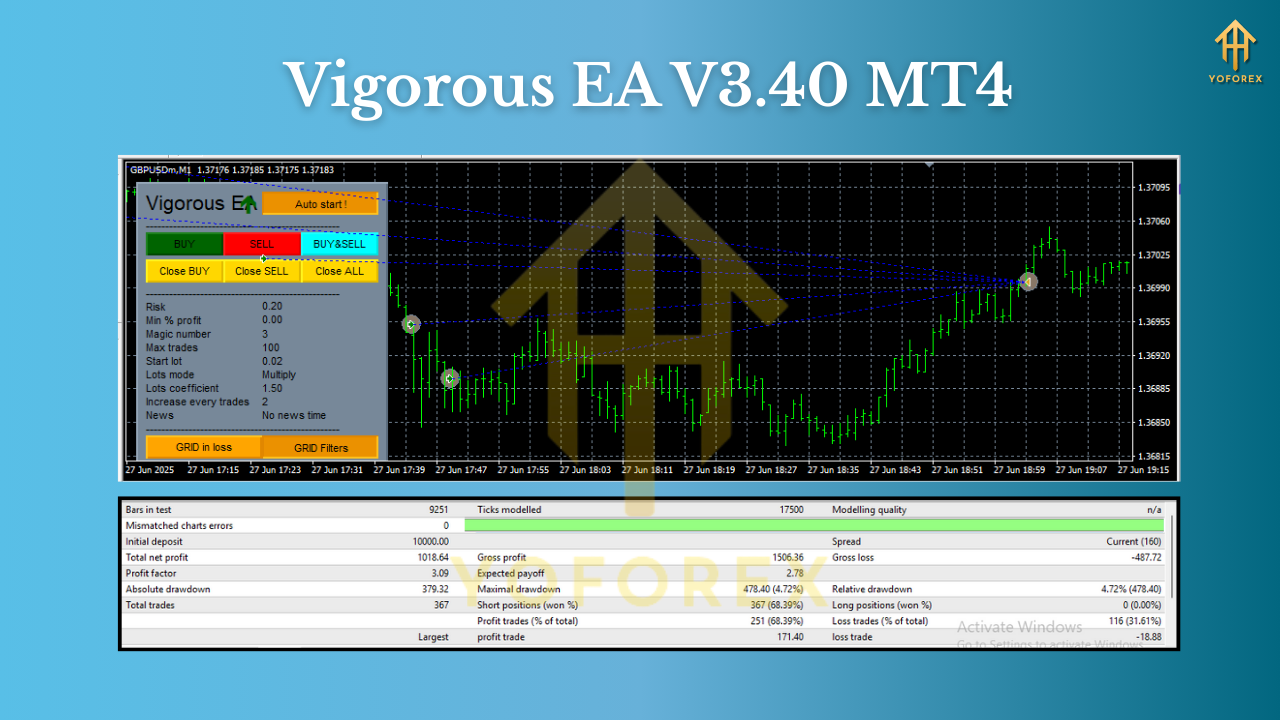
Where this EA stands out:
- Works across major FX pairs (EURUSD, GBPUSD, USDJPY, USDCAD), two crosses (CADJPY, GBPCHF), plus XAUUSD and BTCUSD for traders who want diversification.
- Prioritizes speed, spread control, and risk boundaries—critical for M1.
- Includes news-pause logic and a daily loss cap option to protect your account on chaotic sessions.
It’s built for ECN/Raw spread accounts with fast execution and low commission. If your broker consistently shows wider than normal spreads during peak sessions, results will vary—M1 scalpers live and die by fill quality.
How Vigorous EA V3.40 MT4 Works (In Plain English)
At a high level, Vigorous EA V3.40 MT4 looks for alignment between micro-trend direction (measured by short-horizon moving averages and price structure) and real-time volatility stability (ATR-derived). If spreads are within a defined threshold and the session isn’t about to roll into a risky news event, it opens small, time-boxed positions with tight stops and pre-defined partial take-profits. The logic expects some trades to scratch or take a small loss—because on M1, the edge is the sum of many disciplined executions, not one moonshot.
Key safeguards:
- Max Spread Filter: Trades are blocked if spread > your limit.
- Slippage Guard: Cancels or avoids entries when slippage is excessive.
- Streak Protection: Reduces risk after a sequence of losses; steps back to base once conditions stabilize.
- Daily Loss Guard: Optional global cap that stops trading for the day after a defined drawdown.
Recommended Markets & Sessions
- EURUSD, GBPUSD, USDJPY, USDCAD: Core pairs. Trade during London and New York overlaps for tighter spreads.
- CADJPY, GBPCHF: Good for additional signals but keep a stricter spread cap.
- XAUUSD (Gold): Offers powerful micro-moves; ensure raw spreads and adequate margin. Consider slightly larger stop to account for gold’s spikiness.
- BTCUSD: Best during higher liquidity windows. If your broker widens spreads overnight or on weekends (synthetic crypto books), disable BTCUSD then.
Features You’ll Actually Use
- M1-Optimized Scalping Core: Tuned for speed and micro-momentum.
- Multi-Asset Support: CADJPY, EURUSD, GBPUSD, GBPCHF, USDCAD, USDJPY, XAUUSD, BTCUSD.
- Spread & Slippage Filters: Only trade when conditions are tradable.
- Session Map & News Pause: Avoids thin or chaotic liquidity windows.
- Dynamic Lot Sizing (Risk%): Position sizes scale with balance.
- Partial TP + Time-Based Exit: Lock small gains; avoid overstaying.
- Hard SL on Every Trade: No martingale, no grid, no averaging down.
- Daily Loss/Win Caps: Stop after a good day; protect after a rough one.
- Magic Number per Pair: Clean tracking and analytics.
- Verbose Logs: Quick troubleshooting and backtesting comparability.
Setup & Best-Practice Settings
Account Type: ECN/Raw with 1:200–1:500 leverage.
VPS: Yes—low-latency (≤5–20 ms) to your broker.
Timeframe: Attach on M1 only (one chart per symbol).
Core Inputs to Review:
- Risk per Trade (%): Start 0.5%–1.0%; scale only after weeks of data.
- Max Spread (points): Tailor per symbol; e.g., EURUSD lower than XAUUSD.
- Slippage (points): Keep realistic; test your broker fills.
- Session Hours: Enable London/NY overlaps; disable dead hours.
- News Filter: Pause around high-impact events (NFP, CPI, FOMC).
- Daily Loss Cap: e.g., 3–5% then halt until next day.
- Per-Symbol Toggle: If a pair underperforms on your broker, disable it.
Lot Sizing Tip: Prefer risk-based lots over fixed volume. It keeps drawdowns proportional as the balance changes.
Backtesting & Forward Testing Tips
- Quality Data: For M1 bots, use tick-by-tick with true variable spreads and commission. A fixed-spread backtest can look flattering but won’t reflect reality.
- Symbol-Specific: Backtest each symbol independently. XAUUSD and BTCUSD will behave very differently from EURUSD.
- Broker Conditions: If your broker widens spreads at rollovers or session handoffs, sync your session map to avoid those zones.
- Walk-Forward: After a few solid backtest periods, do a forward test on demo for 2–4 weeks to confirm fills and slippage resemble expectations.
- Evaluation Metrics: Track profit factor, average trade duration, average win vs loss, win rate, and max drawdown per symbol. On M1, average duration should remain short (minutes), not hours.
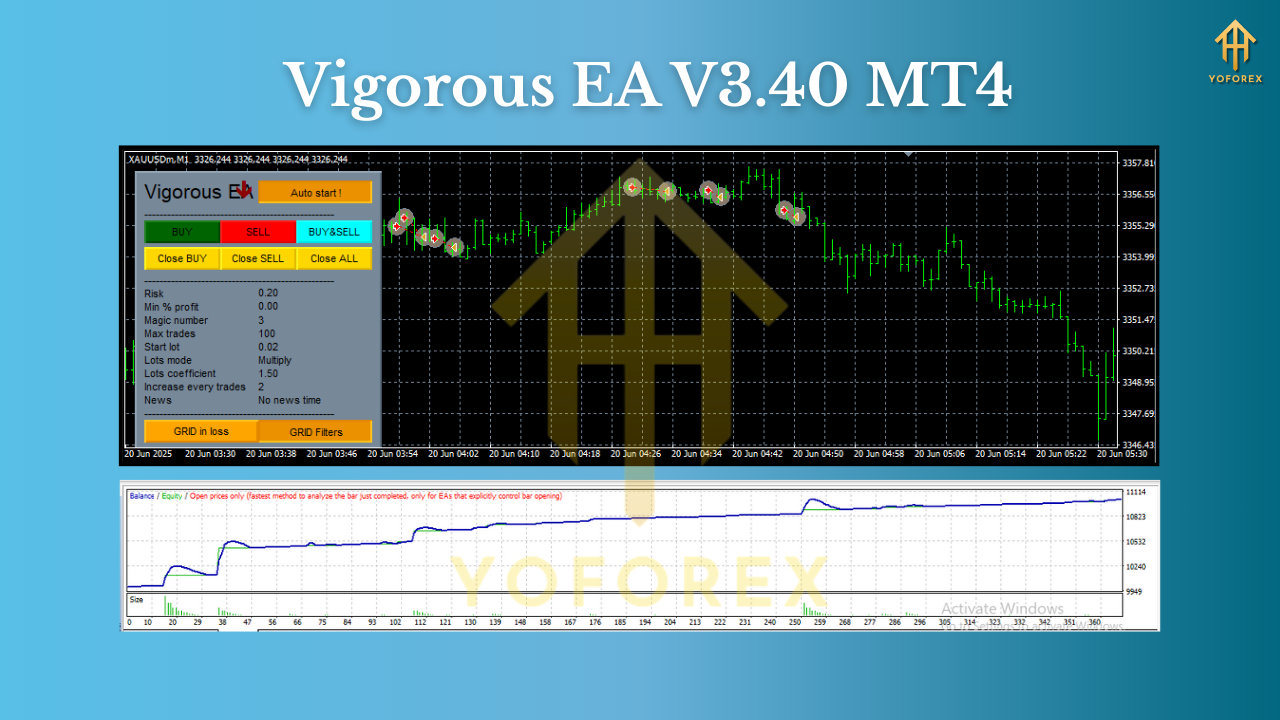
Risk Management & Expectations
No M1 scalper wins every day. Aim for consistency over drama:
- Keep risk per trade modest; the edge compounds through frequency.
- Use daily stop so one bizarre session doesn’t ruin your week.
- Avoid martingale/grid temptations—Vigorous EA V3.40 MT4 intentionally doesn’t use them.
- Consider prop-firm rules: If you’re trading evaluations, align daily loss caps and max positions with the firm’s policy.
A realistic approach: Focus on stable weekly curves, not single-day heroics. If spreads blow out or slippage jumps, stand down. Discipline beats hustle on M1.
Pair-by-Pair Quick Notes
- EURUSD: Core engine; tight spreads; reliable fills during London/NY.
- GBPUSD: Stronger impulses; widen SL a touch vs EURUSD.
- USDJPY: Often smooth micro-trends; spread is usually friendly.
- USDCAD: Can be choppy around oil/calendar; watch news blocks.
- CADJPY: Good mover; apply stricter spread filter than majors.
- GBPCHF: Can “snap”; keep conservative risk and enforce time-based exits.
- XAUUSD (Gold): Big micro-volatility; use broader SL, partial TP is your friend.
- BTCUSD: Only trade when liquidity is adequate; widen filters to reflect volatility.
Troubleshooting Checklist
- Getting “No Trade” Logs? Check spread filter; your cap may be too tight for current conditions.
- Frequent Slippage Errors? Lower lot size; verify VPS latency; avoid news windows.
- Equity Bumps Then Dips? Reduce risk per trade; enable partial TP; stop after daily target.
- One Pair Drags Results Down? Disable it for a week; focus on the top two performers on your broker.
Final Thoughts
Vigorous EA V3.40 MT4 is purpose-built for traders who want an M1 scalper that respects risk. It won’t chase extremes or add into losers; it filters for tradable conditions and aims to clip repeatable, small gains across a diverse symbol list. Keep the environment clean (VPS, raw spreads), start conservative on risk, and evaluate per pair. With a systematic setup and patience, you’ll gather the kind of data that actually means something—and that’s where the edge begins.
Join our Telegram for the latest updates and support

Comments (0)
No comments yet. Be the first to comment!
Leave a Comment