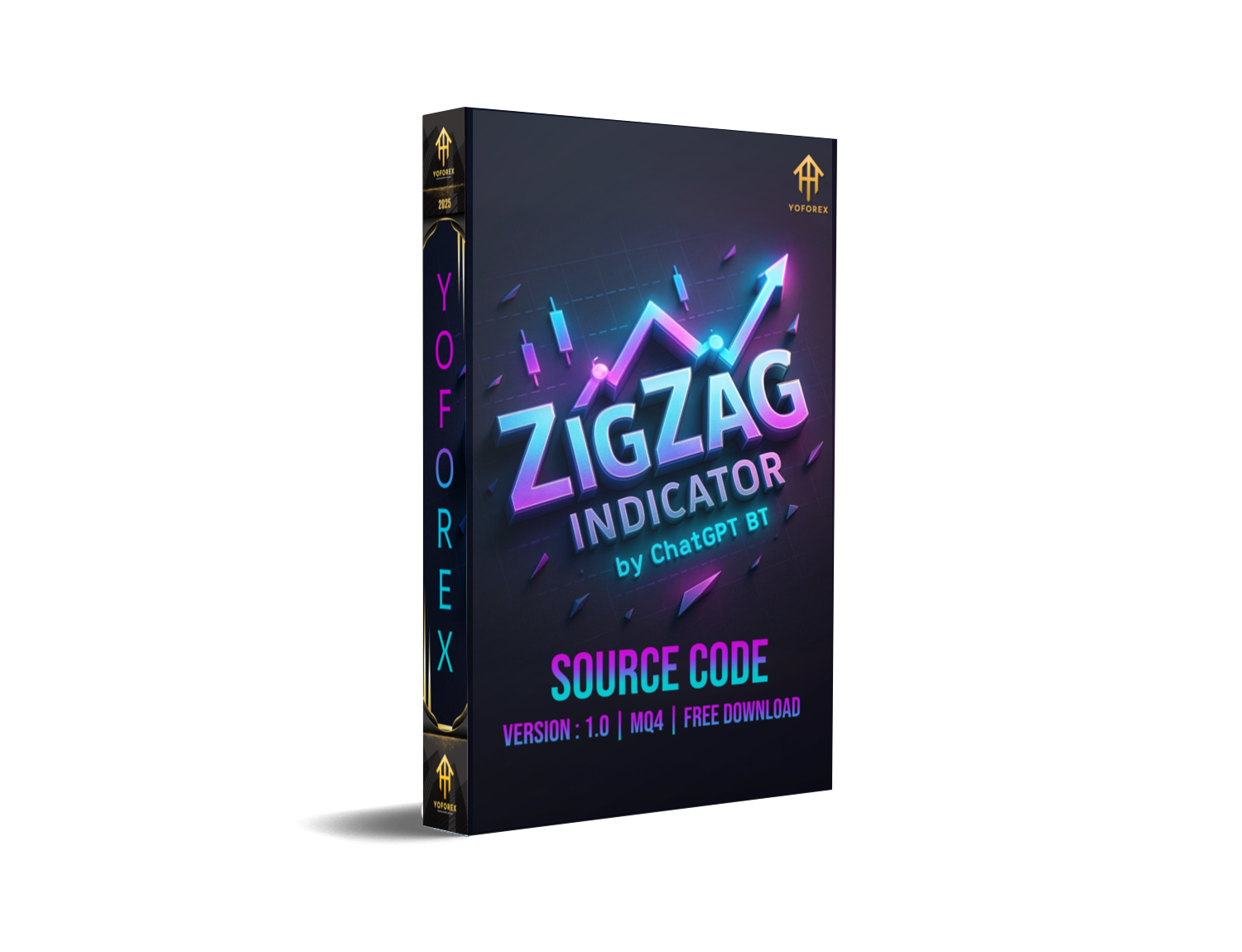
Tired of staring at choppy charts trying to guess where the “real” swing highs and lows are? The ZigZag Indicator by ChatGPT BT V1.0 is a clean, no-nonsense way to filter market noise and highlight the structure that actually matters. If you’re into pullback entries, swing trading, or you just want a clearer roadmap for trend continuation vs reversal, ZigZag is that trusty friend who tidies up the mess so you can think straight. It doesn’t predict the future (nothing does), but it does an awesome job of summarizing price action—so you can make decisions faster and with fewer second guesses.
Unlike flashy oscillators, ZigZag draws lines only when price has moved enough to matter. That’s the whole magic. By setting thresholds for movement (Deviation), the indicator ignores tiny fluctuations and plots meaningful swing points. You’ll see structure—higher highs/higher lows in an uptrend, or lower highs/lower lows in a downtrend—without the clutter. And coz it’s visual and intuitive, you’ll pick it up in minutes.
What Is the ZigZag Indicator (and Why This Version)?
At its core, ZigZag connects significant swing highs and lows to display the skeleton of market movement. This version—ChatGPT BT V1.0—sticks to the classic logic so your chart remains consistent with what you’ve seen in trading guides and mentors’ streams. It’s light, efficient, and flexible enough to slot into almost any strategy:
- Scalpers (M1–M5): Use tighter settings to catch micro-swings and pullbacks to the intraday trend.
- Day traders (M5–M30): Map session structure and fade invalid breaks, or trade continuation pullbacks.
- Swing traders (H1–D1): Mark major swing points, then layer confluence (Fibonacci, supply/demand zones, MAs).
The indicator doesn’t repaint a “fixed” past to trick you; it updates the final leg as price evolves, like any legitimate ZigZag. That’s normal behavior and actually useful—it keeps the structure aligned with real-time price, not a fantasy snapshot.

Key Parameters (Recommended Starting Points)
You’ll find three classic inputs (names may vary slightly depending on your MT4 language/skin):
- Depth: How many bars the indicator scans to validate a pivot.
- Start with 12 for M5–M15, 24 for H1, 48 for H4–D1.
- Deviation (points or %): Minimum price change to confirm a swing.
- Start with 50–150 points on FX depending on your broker’s digits; larger for gold/indices.
- Backstep: Minimum bars between two neighboring pivots.
- Start with 3–5.
These aren’t “set in stone.” If your chart still feels noisy, increase Deviation/Depth. If it feels too sparse, reduce them. In short: tune it to the instrument’s average volatility and your trading horizon.
How Traders Actually Use ZigZag (Practical Playbook)
1) Identify Market Structure Quickly
Use ZigZag to draw the HH/HL or LH/LL roadmap. Once you see the structure, planning entries becomes simpler: buy pullbacks in an uptrend near the last higher low area; sell rallies in a downtrend near the last lower high.
2) Confluence with Fibonacci
ZigZag swing points are perfect anchor points for Fibonacci retracements. A common combo: wait for a pullback to the 38.2%–61.8% zone that aligns with a prior ZigZag swing, then enter with a tight stop.
3) Trend Filters
Layer a 200 EMA to tag the broader bias. Longs only above the 200 EMA; shorts only below. ZigZag gives you the swing map, the EMA gives you the traffic direction.
4) Break-of-Structure Confirmation
When the most recent higher low gets broken decisively (close beyond it), the trend may be shifting. ZigZag helps you “see” that break faster and frame a new plan.
5) Risk Placement
Because ZigZag pins the key pivot, your stop-loss can often tuck just beyond that swing, trimming risk without getting silly. Pair with ATR(14) for dynamic buffers if the instrument is jumpy (hello, gold).
Feature Highlights
- • Noise filtering: Cuts the chart clutter so you can focus on actual swings.
- • Universal use: Works on any timeframe and any symbol your broker offers.
- • Customizable sensitivity: Depth, Deviation, Backstep let you dial in the perfect balance.
- • Structure clarity: Instantly visualize HH/HL or LH/LL sequences.
- • Confluence-friendly: Plays nicely with Fibs, MAs, RSI, supply/demand, you name it.
- • Lightweight code: Minimal CPU footprint—even with multiple charts open.
- • Plan entries/exits: Clear pullback zones and logical stop-placement beyond swings.
- • Backtest helper: Use swing anchors to study how your strategy would’ve performed (manually or with a tester).
- • Simple UI: Drop it on the chart and go—no massive learning curve.
- • Clean visuals: Crisp lines that don’t hijack your chart theme.
Installation & Setup (MT4 in a Minute)
- Download the file
ZigZag_ChatGPT_BT_V1.0.mq4. - In MT4, click File → Open Data Folder →
MQL4/Indicators. - Copy the
.mq4into the Indicators folder. - In MT4, open Navigator (Ctrl+N) → right-click Indicators → Refresh (or restart MT4).
- Drag ZigZag Indicator by ChatGPT BT V1.0 onto your chart.
- In Inputs, start with: Depth 12, Deviation 100 (FX), Backstep 3 and tune from there.
- Optional: Save as a Template so you can apply it to new charts with one click.
Tip: If your broker uses 5-digit quotes (0.00001 on EURUSD), remember your Deviation is in points; scale accordingly. For gold and indices, bump Deviation higher to match volatility.

Strategy Examples (Use, Don’t Abuse)
A) Trend Pullback (Intraday)
- Timeframe: M5/M15
- Filters: 200 EMA for bias, RSI(14) for momentum confirmation
- Entry: In an uptrend (price above 200 EMA), wait for a ZigZag swing higher low + RSI pullback to 40–50. Enter long on bullish candle close.
- Stop: Just below the prior ZigZag swing low (plus ATR buffer).
- Target: Prior swing high or a 1.5–2.0R fixed target.
B) Reversal Probe (Swing)
- Timeframe: H1/H4
- Filters: Key S/R, supply/demand zones
- Entry: After an extended run, price prints a fresh ZigZag swing against the trend at a major level. Wait for a two-bar confirmation (engulfing or pin).
- Stop: Beyond the reversal pivot.
- Target: First major opposing swing or 2R.
Not every ZigZag leg is a trade—context matters. That’s the deal with any price-action tool. But if you combine ZigZag with a simple bias filter, a timing signal, and clear risk rules, you’ll likely feel more confident and less “random.”
Risk & Money Management (Quick Reality Check)
An indicator is not a license to oversize. Even with a crystal-clear swing map, losing trades will occur. Keep risk per trade in the 0.5%–1% range; never chase a move after it’s gone. If you’re new or running a small account (say the $100 minimum mentioned above), treat live trading as practice with discipline—and don’t hesitate to stay on demo until your process clicks. Past performance doesn’t guarantee future results; you know the drill, but it bears repeating.
Final Thoughts
If you’ve been craving a cleaner read on market structure, the ZigZag Indicator by ChatGPT BT V1.0 (MQ4) is a simple, dependable way to “see” swings the way seasoned traders do. It won’t tell you which leg is next—but it will help you frame high-quality trade ideas, place smarter stops, and avoid a lot of second-guessing. Tune the inputs to your instrument, add one or two confluence tools, stick to your risk rules, and let the structure guide you.
Comments (1)
Embark into the breathtaking galaxy of EVE Online. Shape your destiny today. Explore alongside thousands of players worldwide. Join now
Leave a Comment